
Policy & Procedure
INDEX
|
S. No. |
Name of the Documents |
Page no. |
|
1 |
Rights and Obligation of Beneficial Owner and Depository Participant as prescribed by SEBI & Depositories. (Along-with the Additional Rights And Obligations’ of the Rights and Obligations Document – DDPI) |
2 - 4 |
|
2 |
Right and Obligation of Stock Brokers, Sub-Brokers/Authorised Person and Clients as prescribed by SEBI and Stock Exchange. |
5 – 8 |
|
3 |
Risk and Disclosure documents for capital market and derivative segments. |
9 – 11 |
|
4 |
Guidance note-Do’s and Don’t for trading on the Exchange(s) for Investors. |
12- 13 |
|
5 |
Risk and Disclosure documents for Commodity Market. |
14 – 16 |
|
6 |
Rights and Obligation of Members, Authorised Person and Clients as prescribed by SEBI and Commodity Exchange for Commodity Market. |
17 – 23 |
|
7 |
Internet and Wireless technology based trading facility provided by Stock Brokers to Client. |
24 – 24 |
|
8 |
Guidance note-Do’s and Don’t for the clients for Trading in commodity segment |
25 – 26 |
|
9 |
Policies & Procedure |
27 – 30 |
|
10 |
Most Important Terms and Conditions (MITC) - Annexure - A |
31 – 31 |
|
11 |
Policy For Voluntary Freezing Of Online Access Of Client’s Trading Account |
32 – 32 |
|
12 |
Investor Charter of Stock Brokers |
33 – 36 |
|
13 |
Investor Charter of Depository Participant |
37 – 44 |
|
14 |
Disclosure Information of Pro-Trading |
44 - 44 |
|
Rights and Obligations of Beneficial Owner and Depository Participant as prescribed by SEBI and Depositories |
General Clause
1. The Beneficial Owner and the Depository participant (DP) shall be bound by the provisions of the Depositories Act, 1996, SEBI (Depositories and Participants) Regulations, 2018, Rules and Regulations of Securities and Exchange Board of India (SEBI), Circulars/Notifications/Guidelines issued there under, Bye Laws and Business Rules/Operating Instructions issued by the Depositories and relevant notifications of Government Authorities as may be in force from time to time.
2. The DP shall open/activate demat account of a beneficial owner in the depository system only after receipt of complete Account opening form, KYC and supporting doc`uments as specified by SEBI from time to time.
Beneficial Owner information
3. The DP shall maintain all the details of the beneficial owner(s) as mentioned in the account opening form, supporting documents submitted by them and/or any other information pertaining to the beneficial owner confidentially and shall not disclose the same to any person except as required by any statutory, legal or regulatory authority in this regard.
4. The Beneficial Owner shall immediately notify the DP in writing, if there is any change in details provided in the account opening form as submitted to the DP at the time of opening the demat account or furnished to the DP from time to time.
Fees/Charges/Tariff
5. The Beneficial Owner shall pay such charges to the DP for the purpose of holding and transfer of securities in dematerialized form and for availing depository services as may be agreed to from time to time between the DP and the Beneficial Owner as set out in the Tariff Sheet provided by the DP. It may be informed to the Beneficial Owner that "no charges are payable for opening of demat accounts”
6. In case of Basic Services Demat Accounts, the DP shall adhere to the charge structure as laid down under the relevant SEBI and/or Depository circulars/directions/notifications issued from time to time.
7. The DP shall not increase any charges/tariff agreed upon unless it has given a notice in writing of not less than thirty days to the Beneficial Owner regarding the same.
Dematerialization
8. The Beneficial Owner shall have the right to get the securities, which have been admitted on the Depositories, dematerialized in the form and manner laid down under the Bye Laws, Business Rules and Operating Instructions of the depositories.
Separate Accounts
9. The DP shall open separate accounts in the name of each of the beneficial owners and securities of each beneficial owner shall be segregated and shall not be mixed up with the securities of other beneficial owners and/or DP’s own securities held in dematerialized form.
10. The DP shall not facilitate the Beneficial Owner to create or permit any pledge and /or hypothecation or any other interest or encumbrance over all or any of such securities submitted for dematerialization and/or held in demat account except in the form and manner prescribed in the Depositories Act, 1996, SEBI (Depositories and Participants) Regulations, 2018 and Bye-Laws/Operating Instructions/Business Rules of the Depositories.
Transfer of Securities
11. The DP shall effect transfer to and from the demat accounts of the Beneficial Owner only on the basis of an order, instruction, direction or mandate duly authorized by the Beneficial Owner and the DP shall maintain the original documents and the audit trail of such authorizations.
12. The Beneficial Owner reserves the right to give standing instructions with regard to the crediting of securities in his demat account and the DP shall act according to such instructions.
13. “The stock broker / stock broker and depository participant shall not directly / indirectly compel the clients to execute Power of Attorney (PoA) or Demat Debit and Pledge Instruction (DDPI) or deny services to the client if the client refuses to execute PoA or DDPI.”
Statement of account
14. The DP shall provide statements of accounts to the beneficial owner in such form and manner and at such time as agreed with the Beneficial Owner and as specified by SEBI/depository in this regard.
15. However, if there is no transaction in the demat account, or if the balance has become Nil during the year, the DP shall send one physical statement of holding annually to such BOs and shall resume sending the transaction statement as and when there is a transaction in the account.
16. The DP may provide the services of issuing the statement of demat accounts in an electronic mode if the Beneficial Owner so desires. The DP will furnish to the Beneficial Owner the statement of demat accounts under its digital signature, as governed under the Information Technology Act, 2000. However if the DP does not have the facility of providing the statement of demat account in the electronic mode, then the Participant shall be obliged to forward the statement of demat accounts in physical form.
17. In case of Basic Services Demat Accounts, the DP shall send the transaction statements as mandated by SEBI and/or Depository from time to time.
Manner of Closure of Demat account
18. The DP shall have the right to close the demat account of the Beneficial Owner, for any reasons whatsoever, provided the DP has given a notice in writing of not less than thirty days to the Beneficial Owner as well as to the Depository. Similarly, the Beneficial Owner shall have the right to close his/her demat account held with the DP provided no charges are payable by him/her to the DP. In such an event, the Beneficial Owner shall specify whether the balances in their demat account should be transferred to another demat account of the Beneficial Owner held with another DP or to rematerialize the security balances held.
19. Based on the instructions of the Beneficial Owner, the DP shall initiate the procedure for transferring such security balances or rematerialize such security balances within a period of 2 working days as per procedure specified from time to time by the depository incase of no outstanding dues and in case of outstanding dues, shall provide 30 days notice. In case of non-payment of dues, DP shall reject the account closure request and in case the dues are cleared by BO, respective account shall be closed by DP within 2 working days of clearing the dues. Provided further, closure of demat account shall not affect the rights, liabilities and obligations of either the BO or the DP and shall continue to bind the parties to their satisfactory completion.
Default in payment of charges
20. In event of Beneficial Owner committing a default in the payment of any amount provided in Clause 5 & 6 within a period of thirty days from the date of demand, without prejudice to the right of the DP to close the demat account of the Beneficial Owner, the DP may charge interest at a rate as specified by the Depository from time to time for the period of such default.
21. In case the Beneficial Owner has failed to make the payment of any of the amounts as provided in Clause 5&6 specified above, the DP after giving two days notice to the Beneficial Owner shall have the right to stop processing of instructions of the Beneficial Owner till such time he makes the payment along with interest, if any.
Liability of the Depository
22. As per Section 16 of Depositories Act, 1996,
1. Without prejudice to the provisions of any other law for the time being in force, any loss caused to the beneficial owner due to the negligence of the depository or the participant, the depository shall indemnify such beneficial owner.
2. Where the loss due to the negligence of the participant under Clause (1) above, is indemnified by the depository, the depository shall have the right to recover the same from such participant.
Freezing/ Defreezing of accounts
23. The Beneficial Owner may exercise the right to freeze/defreeze his/her demat account maintained with the DP in accordance with the procedure and subject to the restrictions laid down under the Bye Laws and Business Rules/Operating Instructions.
24. The DP or the Depository shall have the right to freeze/defreeze the accounts of the Beneficial Owners on receipt of instructions received from any regulator or court or any statutory authority.
25. “The Joint holders are aware that in case of any Statutory Order for freezing any one joint holder, the demat account will be frozen and the other joint holders will have to obtain a specific Order for unfreezing their percentage of joint ownership by submitting the relevant documentary proof to the Order issuing authority”.
Redressal of Investor grievance
26. The DP shall redress all grievances of the Beneficial Owner against the DP within a period of thirty days from the date of receipt of the complaint.
Authorized representative
27. If the Beneficial Owner is a body corporate or a legal entity, it shall, along with the account opening form, furnish to the DP, a list of officials authorized by it, who shall represent and interact on its behalf with the Participant. Any change in such list including additions, deletions or alterations thereto shall be forthwith communicated to the Participant.
Law and Jurisdiction
28. In addition to the specific rights set out in this document, the DP and the Beneficial owner shall be entitled to exercise any other rights which the DP or the Beneficial Owner may have under the Rules, Bye Laws and Regulations of the respective Depository in which the demat account is opened and circulars/notices issued there under or Rules and Regulations of SEBI.
29. The provisions of this document shall always be subject to Government notification, any rules, regulations, guidelines and circulars/ notices issued by SEBI and Rules, Regulations and Bye-laws of the relevant Depository, where the Beneficial Owner maintains his/ her account, that may be in force from time to time.
30. The Beneficial Owner and the DP shall abide by the arbitration and conciliation procedure prescribed under the Bye-laws of the depository and that such procedure shall be applicable to any disputes between the DP and the Beneficial Owner.
31. Words and expressions which are used in this document but which are not defined herein shall unless the context otherwise requires, have the same meanings as assigned thereto in the Rules, Bye-laws and Regulations and circulars/notices issued there under by the depository and /or SEBI
32. Any changes in the rights and obligations which are specified by SEBI/Depositories shall also be brought to the notice of the clients at once.
33. If the rights and obligations of the parties hereto are altered by virtue of change in Rules and regulations of SEBI or Bye-laws, Rules and Regulations of the relevant Depository, where the Beneficial Owner maintains his/her account, such changes shall be deemed to have been incorporated herein in modification of the rights and obligations of the parties mentioned in this document
Additional Rights And Obligations’ of the Rights and Obligations Document
Point no. 13 of Transfer of Securities
“The stock broker / stock broker and depository participant shall not directly / indirectly compel the clients to execute Power of Attorney (PoA) or Demat Debit and Pledge Instruction (DDPI) or deny services to the client if the client refuses to execute PoA or DDPI.”
Additional Disclosures For Joint Demat Account Holders
Point no. 25 of Freezing/ Defreezing of accounts
“The Joint holders are aware that in case of any Statutory Order for freezing any one joint holder, the demat account will be frozen and the other joint holders will have to obtain a specific Order for unfreezing their percentage of joint ownership by submitting the relevant documentary proof to the Order issuing authority”.
|
RIGHTS AND OBLIGATIONS OF STOCK BROKERS , SUB-BROKERS AND CLIENTS |
|
ANNEXURE-4 |
As prescribed by SEBI and Stock Exchanges
1. The client shall invest/trade in those securities/contracts/other instruments admitted to dealings on the Exchanges as defined in the Rules, Byelaws and Regulations of Exchanges/ Securities and Exchange Board of India (SEBI) and circulars/notices issued there under from time to time.
2. The stock broker, sub-broker and the client shall be bound by all the Rules, Byelaws and Regulations of the Exchange and circulars/notices issued there under and Rules and Regulations of SEBI and relevant notifications of Government authorities as may be in force from time to time.
3. The client shall satisfy itself of the capacity of the stock broker to deal in securities and/or deal in derivatives contracts and wishes to execute its orders through the stock broker and the client shall from time to time continue to satisfy itself of such capability of the stock broker before executing orders through the stock broker.
4. The stock broker shall continuously satisfy itself about the genuineness and financial soundness of the client and investment objectives relevant to the services to be provided.
5. The stock broker shall take steps to make the client aware of the precise nature of the Stock broker’s liability for business to be conducted, including any limitations, the liability and the capacity in which the stock broker acts.
CLIENT INFORMATION
6. The client shall furnish all such details in full as are required by the stock broker in "Account Opening Form” with supporting details, made mandatory by stock exchanges/SEBI from time to time.
7. The client shall familiarize himself with all the mandatory provisions in the Account Opening documents. Any additional clauses or documents specified by the stock broker shall be non-mandatory, as per terms & conditions accepted by the client.
8. The client shall immediately notify the stock broker in writing if there is any change in the information in the ‘account opening form’ as provided at the time of account opening and thereafter; including the information on winding up petition/insolvency petition or any litigation which may have material bearing on his capacity. The client shall provide/update the financial information to the stock broker on a periodic basis.
9. The stock broker shall maintain all the details of the client as mentioned in the account opening form or any other information pertaining to the client, confidentially and that they shall not disclose the same to any person/authority except as required under any law/regulatory requirements. Provided however that the stock broker may so disclose information about his client to any person or authority with the express permission of the client.
MARGINS
10. The client shall pay applicable initial margins, withholding margins, special margins or such other margins as are considered necessary by the stock broker or the Exchange or as may be directed by SEBI from time to time as applicable to the segment(s) in which the client trades. The stock broker is permitted in its sole and absolute discretion to collect additional margins (even though not required by the Exchange, Clearing House/Clearing Corporation or SEBI) and the client shall be obliged to pay such margins within the stipulated time.
11. The client understands that payment of margins by the client does not necessarily imply complete satisfaction of all dues. In spite of consistently having paid margins, the client may, on the settlement of its trade, be obliged to pay (or entitled to receive) such further sums as the contract may dictate/require.
TRANSACTIONS AND SETTLEMENTS
12. The client shall give any order for buy or sell of a security/derivatives contract in writing or in such form or manner, as may be mutually agreed between the client and the stock broker. The stock broker shall ensure to place orders and execute the trades of the client, only in the Unique Client Code assigned to that client.
13. The stock broker shall inform the client and keep him apprised about trading/settlement cycles, delivery/payment schedules, any changes therein from time to time, and it shall be the responsibility in turn of the client to comply with such schedules/procedures of the relevant stock exchange where the trade is executed.
14. The stock broker shall ensure that the money/securities deposited by the client shall be kept in a separate account, distinct from his/its own account or account of any other client and shall not be used by the stock broker for himself/itself or for any other client or for any purpose other than the purposes mentioned in Rules, Regulations, circulars, notices, guidelines of SEBI and/or Rules, Regulations, Bye-laws, circulars and notices of Exchange.
15. Where the Exchange(s) cancels trade(s) suo moto all such trades including the trade/s done on behalf of the client shall ipso facto stand cancelled, stock broker shall be entitled to cancel the respective contract(s) with client(s).
16. The transactions executed on the Exchange are subject to Rules, Byelaws and Regulations and circulars/notices issued thereunder of the Exchanges where the trade is executed and all parties to such trade shall have submitted to the jurisdiction of such court as may be specified by the Byelaws and Regulations of the Exchanges where the trade is executed for the purpose of giving effect to the provisions of the Rules, Byelaws and Regulations of the Exchanges and the circulars/notices issued thereunder.
BROKERAGE
17. The Client shall pay to the stock broker brokerage and statutory levies as are prevailing from time to time and as they apply to the Client’s account, transactions and to the services that stock broker renders to the Client. The stock broker shall not charge brokerage more than the maximum brokerage permissible as per the rules, regulations and byelaws of the relevant stock exchanges and/or rules and regulations of SEBI.
LIQUIDATION AND CLOSE OUT OF POSITION
18. Without prejudice to the stock broker's other rights (including the right to refer a matter to arbitration), the client understands that the stock broker shall be entitled to liquidate/close out all or any of the client's positions for nonpayment of margins or other amounts, outstanding debts, etc. and adjust the proceeds of such liquidation/close out, if any, against the client's liabilities/obligations. Any and all losses and financial charges on account of such liquidation/closing-out shall be charged to and borne by the client.
19. In the event of death or insolvency of the client or his/its otherwise becoming incapable of receiving and paying for or delivering or transferring securities which the client has ordered to be bought or sold, stock broker may close out the transaction of the client and claim losses, if any, against the estate of the client. The client or his nominees, successors, heirs and assignee shall be entitled to any surplus which may result there from. The client shall note that transfer of funds/securities in favor of a Nominee shall be valid discharge by the stock broker against the legal heir.
20. The stock broker shall bring to the notice of the relevant Exchange the information about default in payment/delivery and related aspects by a client. In case where defaulting client is a corporate entity/partnership/proprietary firm or any other artificial legal entity, then the name(s) of Director(s)/Promoter(s)/Partner(s)/Proprietor as the case may be, shall also be communicated by the stock broker to the relevant Exchange(s).
DISPUTE RESOLUTION
21. The stock broker shall provide the client with the relevant contact details of the concerned Exchanges and SEBI.
22. The stock broker shall co-operate in redressing grievances of the client in respect of all transactions routed through it and in removing objections for bad delivery of shares, rectification of bad delivery, etc.
23. The client and the stock broker shall refer any claims and/or disputes with respect to deposits, margin money, etc., to arbitration as per the Rules, Byelaws and Regulations of the Exchanges where the trade is executed and circulars/notices issued thereunder as may be in force from time to time.
24. The stock broker shall ensure faster settlement of any arbitration proceedings arising out of the transactions entered into between him vis-à-vis the client and he shall be liable to implement the arbitration awards made in such proceedings.
25. The client/stock-broker understands that the instructions issued by an authorized representative for dispute resolution, if any, of the client/stock-broker shall be binding on the client/stock-broker in accordance with the letter authorizing the said representative to deal on behalf of the said client/stock-broker.
TERMINATION OF RELATIONSHIP
26. This relationship between the stock broker and the client shall be terminated; if the stock broker for any reason ceases to be a member of the stock exchange including cessation of membership by reason of the stock broker's default, death, resignation or expulsion or if the certificate is cancelled by the Board.
27. The stock broker, sub-broker and the client shall be entitled to terminate the relationship between them without giving any reasons to the other party, after giving notice in writing of not less than one month to the other parties. Notwithstanding any such termination, all rights, liabilities and obligations of the parties arising out of or in respect of transactions entered into prior to the termination of this relationship shall continue to subsist and vest in/be binding on the respective parties or his/its respective heirs, executors, administrators, legal representatives or successors, as the case may be.
ADDITIONAL RIGHTS AND OBLIGATIONS
28. The stock broker shall ensure due protection to the client regarding client’s rights to dividends, rights or bonus shares, etc. in respect of transactions routed through it and it shall not do anything which is likely to harm the interest of the client with whom and for whom they may have had transactions in securities.
29. The stock broker and client shall reconcile and settle their accounts from time to time as per the Rules, Regulations, Bye Laws, Circulars, Notices and Guidelines issued by SEBI and the relevant Exchanges where the trade is executed.
30. The stock broker shall issue a contract note to his constituents for trades executed in such format as may be prescribed by the Exchange from time to time containing records of all transactions including details of order number, trade number, trade time, trade price, trade quantity, details of the derivatives contract, client code, brokerage, all charges levied etc. and with all other relevant details as required therein to be filled in and issued in such manner and within such time as prescribed by the Exchange. The stock broker shall send contract notes to the investors within one working day of the execution of the trades in hard copy and/or in electronic form using digital signature.
31. The stock broker shall make pay out of funds or delivery of securities, as the case may be, to the Client within one working day of receipt of the payout from the relevant Exchange where the trade is executed unless otherwise specified by the client and subject to such terms and conditions as may be prescribed by the relevant Exchange from time to time where the trade is executed.
32. The stock broker shall send a complete `Statement of Accounts’ for both funds and securities in respect of each of its clients in such periodicity and format within such time, as may be prescribed by the relevant Exchange, from time to time, where the trade is executed. The Statement shall also state that the client shall report errors, if any, in the Statement within such time as may be prescribed by the relevant Exchange from time to time where the trade was executed, from the receipt thereof to the Stock broker.
33. The stock broker shall send daily margin statements to the clients. Daily Margin statement should include, inter-alia, details of collateral deposited, collateral utilized and collateral status (available balance/due from client) with break up in terms of cash, Fixed Deposit Receipts (FDRs), Bank Guarantee and securities.
34. The Client shall ensure that it has the required legal capacity to, and is authorized to, enter into the relationship with stock broker and is capable of performing his obligations and undertakings hereunder. All actions required to be taken to ensure compliance of all the transactions, which the Client may enter into shall be completed by the Client prior to such transaction being entered into.
35. The stock broker / stock broker and depository participant shall not directly /indirectly compel the clients to execute Power of Attorney (PoA) or Demat Debit and Pledge Instruction (DDPI) or deny services to the client if the client refuses to execute PoA or DDPI.
ELECTRONIC CONTRACT NOTES (ECN)
36. In case, client opts to receive the contract note in electronic form, he shall provide an appropriate e-mail id to the stock broker. The client shall communicate to the stock broker any change in the email-id through a physical letter. If the client has opted for internet trading, the request for change of email id may be made through the secured access by way of client specific user id and password.
37. The stock broker shall ensure that all ECNs sent through the e-mail shall be digitally signed, encrypted, non-tamper able and in compliance with the provisions of the IT Act, 2000. In case, ECN is sent through e-mail as an attachment, the attached file shall also be secured with the digital signature, encrypted and non-tamperable.
38. The client shall note that non-receipt of bounced mail notification by the stock broker shall amount to delivery of the contract note at the e-mail ID of the client.
39. The stock broker shall retain ECN and acknowledgement of the e-mail in a soft and non-tamperable form in the manner prescribed by the exchange in compliance with the provisions of the IT Act, 2000 and as per the extant rules/regulations/ circulars/guidelines issued by SEBI/Stock Exchanges from time to time. The proof of delivery i.e., log report generated by the system at the time of sending the contract notes shall be maintained by the stock broker for the specified period under the extant regulations of SEBI/stock exchanges. The log report shall provide the details of the contract notes that are not delivered to the client/e-mails rejected or bounced back. The stock broker shall take all possible steps to ensure receipt of notification of bounced mails by him at all times within the stipulated time period under the extant regulations of SEBI/stock exchanges.
40. The stock broker shall continue to send contract notes in the physical mode to such clients who do not opt to receive the contract notes in the electronic form. Wherever the ECNs have not been delivered to the client or has been rejected (bouncing of mails) by the e-mail ID of the client, the stock broker shall send a physical contract note to the client within the stipulated time under the extant regulations of SEBI/stock exchanges and maintain the proof of delivery of such physical contract notes.
41. In addition to the e-mail communication of the ECNs to the client, the stock broker shall simultaneously publish the ECN on his designated web-site, if any, in a secured way and enable relevant access to the clients and for this purpose, shall allot a unique user name and password to the client, with an option to the client to save the contract note electronically and/or take a print out of the same.
LAW AND JURISDICTION
42. In addition to the specific rights set out in this document, the stock broker, sub-broker and the client shall be entitled to exercise any other rights which the stock broker or the client may have under the Rules, Bye-laws and Regulations of the Exchanges in which the client chooses to trade and circulars/notices issued thereunder or Rules and Regulations of SEBI.
43. The provisions of this document shall always be subject to Government notifications, any rules, regulations, guidelines and circulars/notices issued by SEBI and Rules, Regulations and Bye laws of the relevant stock exchanges, where the trade is executed, that may be in force from time to time.
44. The stock broker and the client shall abide by any award passed by the Arbitrator(s) under the Arbitration and Conciliation Act, 1996. However, there is also a provision of appeal within the stock exchanges, if either party is not satisfied with the arbitration award.
45. Words and expressions which are used in this document but which are not defined herein shall, unless the context otherwise requires, have the same meaning as assigned thereto in the Rules, Byelaws and Regulations and circulars/notices issued thereunder of the Exchanges/SEBI.
46. All additional voluntary clauses/document added by the stock broker should not be in contravention with rules/regulations/notices/circulars of Exchanges/SEBI. Any changes in such voluntary clauses/document(s) need to be preceded by a notice of 15 days. Any changes in the rights and obligations which are specified by Exchanges/SEBI shall also be brought to the notice of the clients.
47. If the rights and obligations of the parties hereto are altered by virtue of change in Rules and regulations of SEBI or Byelaws, Rules and Regulations of the relevant stock Exchanges where the trade is executed, such changes shall be deemed to have been incorporated herein in modification of the rights and obligations of the parties mentioned in this document.
|
RISK DISCLOSURE DOCUMENT FOR CAPITAL MARKET AND DERIVATIVES SEGMENTS |
|
ANNEXURE-5 |
This document contains important information on trading in Equities/Derivatives Segments of the stock exchanges. All prospective constituents should read this document before trading in Equities/Derivatives Segments of the Exchanges. Stock exchanges/SEBI does neither singly or jointly and expressly nor impliedly guarantee nor make any representation concerning the completeness, the adequacy or accuracy of this disclosure document nor have Stock exchanges /SEBI endorsed or passed any merits of participating in the trading segments. This brief statement does not disclose all the risks and other significant aspects of trading.
In the light of the risks involved, you should undertake transactions only if you understand the nature of the relationship into which you are entering and the extent of your exposure to risk.
You must know and appreciate that trading in Equity shares, derivatives contracts or other instruments traded on the Stock Exchange, which have varying element of risk, is generally not an appropriate avenue for someone of limited resources/limited investment and/or trading experience and low risk tolerance. You should therefore carefully consider whether such trading is suitable for you in the light of your financial condition. In case you trade on Stock exchanges and suffer adverse consequences or loss, you shall be solely responsible for the same and Stock exchanges/its Clearing Corporation and/or SEBI shall not be responsible, in any manner whatsoever, for the same and it will not be open for you to take a plea that no adequate disclosure regarding the risks involved was made or that you were not explained the full risk involved by the concerned stock broker.
The constituent shall be solely responsible for the consequences and no contract can be rescinded on that account. You must acknowledge and accept that there can be no guarantee of profits or no exception from losses while executing orders for purchase and/or sale of a derivative contract being traded on Stock exchanges.
It must be clearly understood by you that your dealings on Stock exchanges through a stock broker shall be subject to your fulfilling certain formalities set out by the stock broker, which may inter alia include your filling the know your client form, reading the rights and obligations, do’s and don’ts, etc., and are subject to the Rules, Byelaws and Regulations of relevant Stock exchanges, its Clearing Corporation, guidelines prescribed by SEBI and in force from time to time and Circulars as may be issued by Stock exchanges or its Clearing Corporation and in force from time to time.
Stock exchanges does not provide or purport to provide any advice and shall not be liable to any person who enters into any business relationship with any stock broker of Stock exchanges and/or any third party based on any information contained in this document. Any information contained in this document must not be construed as business advice. No consideration to trade should be made without thoroughly understanding and reviewing the risks involved in such trading. If you are unsure, you must seek professional advice on the same.
In considering whether to trade or authorize someone to trade for you, you should be aware of or must get acquainted with the following:-
1. BASIC RISKS:
1.1 Risk of Higher Volatility
Volatility refers to the dynamic changes in price that a security/derivatives contract undergoes when trading activity continues on the Stock Exchanges. Generally, higher the volatility of a security/derivatives contract, greater is its price swings. There may be normally greater volatility in thinly traded securities / derivatives contracts than in active securities /derivatives contracts. As a result of volatility, your order may only be partially executed or not executed at all, or the price at which your order got executed may be substantially different from the last traded price or change substantially thereafter, resulting in notional or real losses.
1.2 Risk of Lower Liquidity
Liquidity refers to the ability of market participants to buy and/or sell securities / derivatives contracts expeditiously at a competitive price and with minimal price difference. Generally, it is assumed that more the numbers of orders available in a market, greater is the liquidity. Liquidity is important because with greater liquidity, it is easier for investors to buy and/or sell securities / derivatives contracts swiftly and with minimal price difference, and as a result, investors are
more likely to pay or receive a competitive price for securities / derivatives contracts purchased or sold.
There may be a risk of lower liquidity in some securities / derivatives contracts as compared to active securities / derivatives contracts. As a result, your order may only be partially executed, or may be executed with relatively greater price difference or may not be executed at all.
1.2.1 Buying or selling securities / derivatives contracts as part of a day trading strategy may also result into losses, because in such a situation, securities / derivatives contracts may have to be sold / purchased at low / high prices, compared to the expected price levels, so as not to have any open position or obligation to deliver or receive a security /derivatives contract.
1.3 Risk of Wider Spreads
Spread refers to the difference in best buy price and best sell price. It represents the differential between the price of buying a security / derivatives contract and immediately selling it or vice versa. Lower liquidity and higher volatility may result in wider than normal spreads for less liquid or illiquid securities / derivatives contracts.
This in turn will hamper better price formation.
1.4 Risk-reducing orders
The placing of orders (e.g., "stop loss” orders, or "limit" orders) which are intended to limit losses to certain amounts may not be effective many a time because rapid movement in market conditions may make it impossible to execute such orders.
1.4.1 A "market" order will be executed promptly, subject to availability of orders on opposite side, without regard to price and that, while the customer may receive a prompt execution of a "market" order, the execution may be at available prices of outstanding orders, which satisfy the order quantity, on price time priority. It may be understood that these prices may be significantly different from the last traded price or the best price in that security / derivatives contract.
1.4.2 A "limit" order will be executed only at the "limit" price specified for the order or a better price. However, while the customer receives price protection, there is a possibility that the order may not be executed at all.
1.4.3 A stop loss order is generally placed "away" from the current price of a stock / derivatives contract, and such order gets activated if and when the security / derivatives contract reaches, or trades through, the stop price. Sell stop orders are entered ordinarily below the current price, and buy stop orders are entered ordinarily above the current price. When the security / derivatives contract reaches the pre -determined price, or trades through such price, the stop loss order converts to a market/limit order and is executed at the limit or better. There is no assurance therefore that the limit order will be executable since a security / derivatives contract might penetrate the pre-determined price, in which case, the risk of such order not getting executed arises, just as with a regular limit order.
1.5 Risk of News Announcements
News announcements that may impact the price of stock / derivatives contract may occur during trading, and when combined with lower liquidity and higher volatility, may suddenly cause an unexpected positive or negative movement in the price of the security / contract.
1.6 Risk of Rumors
Rumors about companies / currencies at times float in the market through word of mouth, newspapers, websites or news agencies, etc. The investors should be wary of and should desist from acting on rumors.
1.7 System Risk
High volume trading will frequently occur at the market opening and before market close. Such high volumes may also occur at any point in the day. These may cause
delays in order execution or confirmation.
1.7.1 During periods of volatility, on account of market participants continuously modifying their order quantity or prices or placing fresh orders, there may be delays in order execution and its confirmations.
1.7.2 Under certain market conditions, it may be difficult or impossible to liquidate a position in the market at a reasonable price or at all, when there are no outstanding orders either on the buy side or the sell side, or if trading is halted in a security / derivatives contract due to any action on account of unusual trading activity or security / derivatives contract hitting circuit filters or for any other reason.
1.8 System/Network Congestion:
Trading on exchanges is in electronic mode, based on satellite/leased line based communications, combination of technologies and computer systems to place and route orders. Thus, there exists a possibility of communication failure or system problems or slow or delayed response from system or trading halt, or any such other problem/glitch whereby not being able to establish access to the trading system/network, which may be beyond control and may result in delay in processing or not processing buy or sell orders either in part or in full. You are cautioned to note that although these problems may be temporary in nature, but when you have outstanding open positions or unexecuted orders, these represent a risk because of your obligations to settle all executed transactions.
2. As far as Derivatives segments are concerned, please note and get yourself acquainted with the following additional features:-
2.1 Effect of "Leverage" or "Gearing":
In the derivatives market, the amount of margin is small relative to the value of the derivatives contract so the transactions are 'leveraged' or 'geared'. Derivatives trading, which is conducted with a relatively small amount of margin, provides the possibility of great profit or loss in comparison with the margin amount. But transactions in derivatives carry a high degree of risk. You should therefore completely understand the following statements before actually trading in derivatives and also trade with caution while taking into account one's circumstances, financial resources, etc. If the prices move against you, you may lose a part of or whole margin amount in a relatively short period of time. Moreover, the loss may exceed the original margin amount.
A. Futures trading involve daily settlement of all positions. Every day the open positions are marked to market based on the closing level of the index / derivatives contract. If the contract has moved against you, you will be required to deposit the amount of loss (notional) resulting from such movement. This amount will have to be paid within a stipulated time frame, generally before commencement of trading on next day.
B. If you fail to deposit the additional amount by the deadline or if an outstanding debt occurs in your account, the stock broker may liquidate a part of or the whole position or substitute securities. In this case, you will be liable for any losses incurred due to such close-outs.
C. Under certain market conditions, an investor may find it difficult or impossible to execute transactions. For example, this situation can occur due to factors such as illiquidity i.e. when there are insufficient bids or offers or suspension of trading due to price limit or circuit breakers etc.
D. In order to maintain market stability, the following steps may be adopted: changes in the margin rate, increases in the cash margin rate or others. These new measures may also be applied to the existing open interests. In such conditions, you will be required to put up additional margins or reduce your positions.
E. You must ask your broker to provide the full details of derivatives contracts you plan to trade i.e. the contract specifications and the associated obligations.
2.2 Currency specific risks:
1. The profit or loss in transactions in foreign currency-denominated contracts, whether they are traded in your own or another jurisdiction, will be affected by fluctuations in currency rates where there is a need to convert from the currency denomination of the contract to another currency.
2. Under certain market conditions, you may find it difficult or impossible to liquidate a position. This can occur, for example when a currency is deregulated or fixed trading bands are widened.
3. Currency prices are highly volatile. Price movements for currencies are influenced by, among other things: changing supply-demand relationships; trade, fiscal, monetary, exchange control programs and policies of governments; foreign political and economic events and policies; changes in national and international interest rates and inflation; currency devaluation; and sentiment of the market place. None of these factors can be controlled by any individual advisor and no assurance can be given that an advisor's advice will result in profitable trades for a participating customer or that a customer will not incur losses from such events.
2.3 Risk of Option holders:
1. An option holder runs the risk of losing the entire amount paid for the option in a relatively short period of time. This risk reflects the nature of an option as a wasting asset which becomes worthless when it expires. An option holder who neither sells his option in the secondary market nor exercises it prior to its expiration will necessarily lose his entire investment in the option. If the price of the underlying does not change in the anticipated direction before the option expires, to an extent sufficient to cover the cost of the option, the investor may lose all or a significant part of his investment in the option.
2. The Exchanges may impose exercise restrictions and have absolute authority to restrict the exercise of options at certain times in specified circumstances.
2.4 Risks of Option Writers:
1. If the price movement of the underlying is not in the anticipated direction, the option writer runs the risks of losing substantial amount.
2. The risk of being an option writer may be reduced by the purchase of other options on the same underlying interest and thereby assuming a spread position or by acquiring other types of hedging positions in the options markets or other markets.
However, even where the writer has assumed a spread or other hedging position, the risks may still be significant. A spread position is not necessarily less risky than a simple 'long' or 'short' position.
3. Transactions that involve buying and writing multiple options in combination, or buying or writing options in combination with buying or selling short the underlying interests, present additional risks to investors. Combination transactions, such as option spreads, are more complex than buying or writing a single option. And it should be further noted that, as in any area of investing, a complexity not well understood is, in itself, a risk factor. While this is not to suggest that combination strategies should not be considered, it is advisable, as is the case with all investments in options, to consult with someone who is experienced and knowledgeable with respect to the risks and potential rewards of combination transactions under various market circumstances.
3. TRADING THROUGH WIRELESS TECHNOLOGY/SMART ORDER ROUTING OR ANY OTHER TECHNOLOGY:
Any additional provisions defining the features, risks, responsibilities, obligations and liabilities associated with securities trading through wireless technology/ smart order routing or any other technology should be brought to the notice of the client by the stock broker.
4. GENERAL
4.1 The term ‘constituent’ shall mean and include a client, a customer or an investor, who deals with a stock broker for the purpose of acquiring and/or selling of securities / derivatives contracts through the mechanism provided by the Exchanges.
4.2 The term ‘stock broker’ shall mean and include a stock broker, a broker or a stock broker, who has been admitted as such by the Exchanges and who holds a registration certificate from SEBI.
|
GUIDANCE NOTE - DO’s AND DON’Ts FOR TRADING ON THE EXCHANGE(S) FOR INVESTORS |
|
ANNEXURE-6 |
BEFORE YOU BEGIN TO TRADE
1. Ensure that you deal with and through only SEBI registered intermediaries. You may check their SEBI registration certificate number from the list available on the Stock exchanges www.nseindia.com, www.bseindia.com, www.msei.in, www.mcxindia.com, www.ncdex.com and SEBI website www.sebi.gov.in.
2. Ensure that you fill the KYC form completely and strike off the blank fields in the KYC form.
3. Ensure that you have read all the mandatory documents viz. Rights and Obligations, Risk Disclosure Document, Policy and Procedure document of the stock broker.
4. Ensure to read, understand and then sign the voluntary clauses, if any, agreed between you and the stock broker. Note that the clauses as agreed between you and the stock broker cannot be changed without your consent.
5. Get a clear idea about all brokerage, commissions, fees and other charges levied by the broker on you for trading and the relevant provisions/ guidelines specified by SEBI/Stock exchanges.
6. Obtain a copy of all the documents executed by you from the stock broker free of charge.
7. In case you wish to execute Power of Attorney (POA) in favour of the Stock broker, authorizing it to operate your bank and demat account, please refer to the guidelines issued by SEBI/Exchanges in this regard.
TRANSACTIONS AND SETTLEMENTS
8. The stock broker may issue electronic contract notes (ECN) if specifically authorized by you in writing. You should provide your email id to the stock broker for the same. Don’t opt for ECN if you are not familiar with computers.
9. Don’t share your internet trading account’s password with anyone.
10. Don’t make any payment in cash to the stock broker.
11. Make the payments by account payee cheque in favour of the stock broker. Don’t issue cheques in the name of subbroker. Ensure that you have a documentary proof of your payment/deposit of securities with the stock broker, stating date, scrip, quantity, towards which bank/ demat account such money or securities deposited and from which bank/ demat account.
12. Note that facility of Trade Verification is available on stock exchanges’ websites, where details of trade as mentioned in the contract note may be verified. Where trade details on the website do not tally with the details mentioned in the contract note, immediately get in touch with the Investors Grievance Cell of the relevant Stock exchange.
13. In case you have given specific authorization for maintaining running account, payout of funds or delivery of securities (as the case may be), may not be made to you within one working day from the receipt of payout from the Exchange. Thus, the stock broker shall maintain running account for you subject to the following conditions:
a) Such authorization from you shall be dated, signed by you only and contains the clause that you may revoke the same at any time.
b) The actual settlement of funds and securities shall be done by the stock broker, at least once in a calendar quarter or month, depending on your preference. While settling the account, the stock broker shall send to you a ‘statement of accounts’ containing an extract from the client ledger for funds and an extract from the register of securities displaying all the receipts/deliveries of funds and securities. The statement shall also explain the retention of funds and securities and the details of the pledged shares, if any.
c) On the date of settlement, the stock broker may retain the requisite securities/funds towards outstanding obligations and may also retain the funds expected to be required to meet derivatives margin obligations for next 5 trading days, calculated in the manner specified by the exchanges. In respect of cash market transactions, the stock broker may retain entire pay-in obligation of funds and securities due from clients as on date of settlement and for next day’s business, he may retain funds/securities/margin to the extent of value of transactions executed on the day of such settlement in the cash market.
d) You need to bring any dispute arising from the statement of account or settlement so made to the notice of the stock broker in writing preferably within 7 (seven) working days from the date of receipt of funds/securities or statement, as the case may be. In case of dispute, refer the matter in writing to the Investors Grievance Cell of the relevant Stock exchanges without delay.
14. In case you have not opted for maintaining running account and pay-out of funds/securities is not received on the next working day of the receipt of payout from the exchanges, please refer the matter to the stock broker. In case there is dispute, ensure that you lodge a complaint in writing immediately with the Investors Grievance Cell of the relevant Stock exchange.
15. Please register your mobile number and email id with the stock broker, to receive trade confirmation alerts/ details of the transactions through SMS or email, by the end of the trading day, from the stock exchanges.
IN CASE OF TERMINATION OF TRADING MEMBERSHIP
16. In case, a stock broker surrenders his membership, is expelled from membership or declared a defaulter; Stock exchanges gives a public notice inviting claims relating to only the "transactions executed on the trading system" of Stock exchange, from the investors. Ensure that you lodge a claim with the relevant Stock exchanges within the stipulated period and with the supporting documents.
17. Familiarize yourself with the protection accorded to the money and/or securities you may deposit with your stock broker, particularly in the event of a default or the stock broker’s insolvency or bankruptcy and the extent to which you may recover such money and/or securities may be governed by the Bye-laws and Regulations of the relevant Stock exchange where the trade was executed and the scheme of the Investors’ Protection Fund in force from time to time.
DISPUTES/ COMPLAINTS
18. Please note that the details of the arbitration proceedings, penal action against the brokers and investor complaints against the stock brokers are displayed on the website of the relevant Stock exchange.
19. In case your issue/problem/grievance is not being sorted out by concerned stock broker/sub-broker then you may take up the matter with the concerned Stock exchange. If you are not satisfied with the resolution of your complaint then you can escalate the matter to SEBI.
20. Note that all the stock broker/sub-brokers have been mandated by SEBI to designate an e-mail ID of the grievance redressal division/compliance officer exclusively for the purpose of registering complaints.
|
RISK DISCLOSURE DOCUMENT |
Annexure–2 |
The Exchange does not expressly or impliedly, guarantee nor make any representation concerning the completeness, the adequacy or accuracy of this disclosure documents nor has the Exchange endorsed or passed any merits of participating in the Commodity Derivatives market/trading. This brief statement does not disclose all of the risks and other significant aspects of trading. You should, therefore, study derivatives trading carefully before becoming involved in it.
In the light of the risks involved, you should undertake transactions only if you understand the nature of the contractual relationship into which you are entering and the extent of your exposure to risk.
You must know and appreciate that investment in commodity futures contracts/ derivatives or other instruments traded on the Commodity Exchange(s), which have varying element of risk, is generally not an appropriate avenue for someone of limited resources/ limited investment and/ or trading experience and low risk tolerance. You should, therefore, carefully consider whether such trading is suitable for you in the light of your financial condition. In case, you trade on the Exchange and suffer adverse consequences or loss, you shall be solely responsible for the same and the Exchange shall not be responsible, in any manner whatsoever, for the same and it will not be open for you to take the plea that no adequate disclosure regarding the risks involved was made or that you were not explained the full risk involved by the concerned member. The Client shall be solely responsible for the consequences and no contract can be rescinded on that account.
You must acknowledge and accept that there can be no guarantee of profits or no exception from losses while executing orders for purchase and/or sale of a commodity derivatives being traded on the Exchange.
It must be clearly understood by you that your dealings on the Exchange through a member shall be subject to your fulfilling certain formalities set out by the member, which may, inter alia, include your filing the know your client form and are subject to Rules, Byelaws and Business Rules of the Exchange guidelines prescribed by SEBI from time to time and circulars as may be issued by the Exchange from time to time.
The Exchange does not provide or purport to provide any advice and shall not be liable to any person who enters into any business relationship with any member of the Exchange and/ or third party based on any information contained in this document. Any information contained in this document must not be construed as business advice/investment advice. No consideration to trade should be made without thoroughly understanding and reviewing the risks involved in such trading. If you are unsure, you must seek professional advice on the same.
In considering whether to trade, you should be aware of or must get acquainted with the following:-
1. Basic Risks involved in the trading of Commodity Futures Contracts and other Commodity Derivatives Instruments on the Exchange.
i. Risk of Higher Volatility
Volatility refers to the dynamic changes in price that commodity derivative contracts undergo when trading activity continues on the Commodity Exchange. Generally, higher the volatility of a commodity derivatives contract, greater is its price swings. There may be normally greater volatility in thinly traded commodity derivatives contracts than in actively traded commodities/ contracts. As a result of volatility, your order may only be partially executed or not executed at all, or the price at which your order got executed may be substantially different from the last traded price or change substantially thereafter, resulting in real losses.
ii. Risk of Lower Liquidity
a. Liquidity refers to the ability of market participants to buy and/ or sell commodity derivative contract expeditiously at a competitive price and with minimal price difference. Generally, it is assumed that more the number of orders available in a market, greater is the liquidity. Liquidity is important because with greater liquidity, it is easier for investors to buy and/ or sell commodity derivatives contracts swiftly and with minimal price difference and as a result, investors are more likely to pay or receive a competitive price for commodity derivative contracts purchased or sold. There may be a risk of lower liquidity in some commodity derivative contracts as compared to active commodity derivative contracts. As a result, your order may only be partially executed, or may be executed with relatively greater price difference or may not be executed at all.
b.. Buying/ Selling without intention of giving and/ or taking delivery of certain commodities may also result into losses, because in such a situation, commodity derivative contracts may have to be squared-off at a low/ high prices, compared to the expected price levels, so as not to have any obligation to deliver/ receive such commodities.
iii. Risk of Wider Spreads
a. Spread refers to the difference in best buy price and best sell price. It represents the differential between the price of buying a commodity derivative and immediately selling it or vice versa. Lower liquidity and higher volatility may result in wider than normal spreads for less liquid or illiquid commodities/ commodity derivatives contracts. This in turn will hamper better price formation.
iv. Risk-reducing orders
a. Most of the Exchanges have a facility for investors to place “limit orders”, “stop loss orders” etc. Placing of such orders (e.g. “stop loss” orders or “limit” orders) which are intended to limit losses to certain amounts may not be effective many a time because rapid movement in market conditions may make it impossible to execute such orders.
b. A “market” order will be executed promptly, subject to availability of orders on opposite side, without regard to price and that while the customer may receive a prompt execution of a “market” order, the execution may be at available prices of outstanding orders, which satisfy the order quantity, on price time priority. It may be understood that these prices may be significantly different from the last traded price or the best price in that commodity derivatives contract.
c. A “limit” order will be executed only at the “limit” price specified for the order or a better price. However, while the client received price protection, there is a possibility that the order may not be executed at all.
d. A stop loss order is generally placed "away" from the current price of a commodity derivatives contract, and such order gets activated if and when the contract reaches, or trades through, the stop price. Sell stop orders are entered ordinarily below the current price, and buy stop orders are entered ordinarily above the current price. When the contract approaches pre-determined price, or trades through such price, the stop loss order converts to a market/limit order and is executed at the limit or better. There is no assurance therefore that the limit order will be executable since a contract might penetrate the pre-determined price, in which case, the risk of such order not getting executed arises, just as with a regular limit order.
v. Risk of News Announcements
a. Traders/Manufacturers make news announcements that may impact the price of the commodities and/or commodity derivatives contracts. These announcements may occur during trading and when combined with lower liquidity and higher volatility may suddenly cause an unexpected positive or negative movement in the price of the commodity/ commodity derivatives contract.
vi. Risk of Rumours
a. Rumours about the price of a commodity at times float in the market through word of mouth, newspaper, websites or news agencies, etc., the investors should be wary of and should desist from acting on rumours.
vii. System Risk
a. High volume trading will frequently occur at the market opening and before market close. Such high volumes may also occur at any point in the day. These may cause delays in order execution or confirmation.
b. During periods of volatility, on account of market participants continuously modifying their order quantity or prices or placing fresh orders, there may be delays in execution of order and its confirmation.
c. Under certain market conditions, it may be difficult or impossible to liquidate a position in the market at a reasonable price or at all, when there are no outstanding orders either on the buy side or the sell side, or if trading is halted in a commodity due to any action on account of unusual trading activity or price hitting circuit filters or for any other reason.
viii. System/ Network Congestion
a. Trading on the Exchange is in electronic mode, based on satellite/ leased line communications, combination of technologies and computer systems to place and route orders. Thus, there exists a possibility of communication failure or system problems or slow or delayed response from system or trading halt, or any such other problem/glitch whereby not being able to establish access to the trading system/network, which may be beyond the control of and may result in delay in processing or not processing buy or sell orders either in part or in full. You are cautioned to note that although these problems may be temporary in nature, but when you have outstanding open positions or unexecuted orders, these represent a risk because of your obligations to settle all executed transactions.
2. As far as Futures Commodity Derivatives are concerned, please note and get yourself acquainted with the following additional features:-
Effect of "Leverage" or "Gearing":
a. The amount of margin is small relative to the value of the commodity derivatives contract so the transactions are 'leveraged' or 'geared'. Commodity Derivatives trading, which is conducted with a relatively small amount of margin, provides the possibility of great profit or loss in comparison with the principal investment amount. But transactions in commodity derivatives carry a high degree of risk. You should therefore completely understand the following statements before actually trading in commodity derivatives contracts and also trade with caution while taking into account one's circumstances, financial resources, etc.
b. Trading in Futures Commodity Derivativesinvolves daily settlement of all positions. Every day the open positions are marked to market based on the closing price. If the closing price has moved against you, you will be required to deposit the amount of loss (notional) resulting from such movement. This margin will have to be paid within a stipulated time frame, generally before commencement of trading on the next day.
c. If you fail to deposit the additional margin by the deadline or if an outstanding debt occurs in your account, the Member of the Exchange may liquidate/square-up a part of or the whole position. In this case, you will be liable for any losses incurred due to such square-up/ Close Outs.
d. Under certain market conditions, an Investor may find it difficult or impossible to execute the transactions. For example, this situation can occur due to factors such as illiquidity i.e. when there are insufficient bids or offers or suspension of trading due to price limit or circuit breakers etc.
e. Steps, such as, changes in the margin rate, increase in the cash margin rate etc. may be adopted in order to maintain market stability. These new measures may be applied to the existing open interests. In such conditions, you will be required to put up additional margins or reduce your positions.
f. You must ask your Member of the Exchange to provide the full details of the commodity derivatives contracts you plan to trade i.e. the contract specifications and the associated obligations.
3. TRADING THROUGH WIRELESS TECHNOLOGY OR ANY OTHER TECHNOLOGY:
Any additional provisions defining the features, risks, responsibilities, obligations and liabilities associated with commodities trading through wireless technology or any other technology should be brought to the notice of the client by the member.
4. General
i. Deposited cash and property:
You should familiarize yourself with the protections accorded to the money or other property you deposit particularly in the event of a firm become insolvent or bankrupt. The extent to which you may recover your money or property may be governed by specific legislation or local rules. In some jurisdictions, property, which has been specifically identifiable as your own, will be pro-rated in the same manner as cash for purposes of distribution in the event of a shortfall. In case of any dispute with the Member of the Exchange, the same shall be subject to arbitration as per the Rules, Bye-laws and Business Rules of the Exchange.
ii. Commission and other charges:
Before you begin to trade, you should obtain a clear explanation of all commissions, fees and other charges for which you will be liable. These charges will affect your net profit (if any) or increase your loss.
iii. For rights and obligations of the Members/Authorised Persons/ clients, please refer to Annexure 3
iv. The term „Constituent‟ shall mean and include a Client, a Customer or an Investor, who deals with a member for the purpose of trading in the commodity derivatives through the mechanism provided by the Exchange.
v. The term „member‟ shall mean and include a Trading Member or a Member/Broker, who has been admitted as such by the Exchange and got a Unique Member Code from SEBI.
|
Additional Risk Disclosure documents for Options Trading |
|
|
Risk of Option holders: 1. An option holder runs the risk of losing the entire amount paid for the option in a relatively short period of time. This risk reflects the nature of an option as a wasting asset which becomes worthless when it expires. An option holder who neither sells his option in the secondary market nor exercises it prior to its expiration will necessarily lose his entire investment in the option. If the price of the underlying does not change in the anticipated direction before the option expires, to an extent sufficient to cover the cost of the option, the investor may lose all or a significant part of his investment in the option. 2. The Exchanges may impose exercise restrictions and have absolute authority to restrict the exercise of options at certain times in specified circumstances.
Risks of Option Writers: 1. If the price movement of the underlying is not in the anticipated direction, the option writer runs the risks of losing substantial amount.
|
2. The risk of being an option writer may be reduced by the purchase of other options on the same underlying interest and thereby assuming a spread position or by acquiring other types of hedging positions in the options markets or other markets. However, even where the writer has assumed a spread or other hedging position, the risks may still be significant. A spread position is not necessarily less risky than a simple 'long' or 'short' position. 3. Transactions that involve buying and writing multiple options in combination, or buying or writing options in combination with buying or selling short the underlying interests, present additional risks to investors. Combination transactions, such as option spreads, are more complex than buying or writing a single option. And it should be further noted that, as in any area of investing, a complexity not well understood is, in itself, a risk factor. While this is not to suggest that combination strategies should not be considered, it is advisable, as is the case with all investments in options, to consult with someone who is experienced and knowledgeable with respect to the risks and potential rewards of combination transactions under various market circumstances. |
|
RIGHTS AND OBLIGATIONS OF MEMBERS, AUTHORIZED PERSONS AND CLIENTS as prescribed by SEBI and Commodity Exchanges |
Annexure – 3 (of KYC Document) |
Commodity Exchanges
1. The client shall invest/trade in those commodities /contracts/other instruments admitted to dealings on the Exchanges as defined in the Rules, Byelaws and Business Rules/ Regulations of Exchanges/SEBI and circulars/notices issued there under from time to time.
2. The Member, Authorized Person and the client shall be bound by all the Rules, Byelaws and Business Rules of the Exchange and circulars/notices issued there under and Rules and Regulations of SEBI and relevant notifications of Government authorities as may be in force from time to time.
3. The client shall satisfy himself of the capacity of the Member to deal in commodities and/or deal in derivatives contracts and wishes to execute its orders through the Member and the client shall from time to time continue to satisfy itself of such capability of the Member before executing orders through the Member.
4. The Member shall continuously satisfy itself about the genuineness and financial soundness of the client and investment objectives relevant to the services to be provided.
5. The Member shall take steps to make the client aware of the precise nature of the Member’s liability for business to be conducted, including any limitations, the liability and the capacity in which the Member acts.
6. Requirements of professional diligence
a. The Member must exercise professional diligence while entering into a financial contract or discharging any obligations under it. b. “professional diligence” means the standard of skill and care that a Member would be reasonably expected to exercise towards a Client, commensurate with-
i. honest market practice;
ii. the principle of good faith;
iii. level of knowledge, experience and expertise of the Client;
iv. the nature and degree of risk embodied in the financial product* or financial service being availed by the Client; and
v. the extent of dependence of the Client on the Member.
*Commodity derivative contract
7. The Authorized Person shall provide necessary assistance and co-operate with the Member in all its dealings with the client(s).
CLIENT INFORMATION
8. The client shall furnish all such details in full as are required by the Member in "Account Opening Form” with supporting details, made mandatory by commodity exchanges/SEBI from time to time.
9. The client shall familiarize himself with all the mandatory provisions in the Account Opening documents. Any additional clauses or documents specified by the Member shall be non-mandatory; therefore, subject to specific acceptance by the client.
10. The client shall immediately notify the Member in writing if there is any change in the information in the ‘account opening form’ as provided at the time of account opening and thereafter; including the information on winding up petition/insolvency petition or any litigation which may have material bearing on his capacity. The client shall provide/update the financial information to the Member on a periodic basis.
11. A. Protection from unfair terms in financial contracts**
a. An unfair term of a non-negotiated contract will be void. b. A term is unfair if it –
i. causes a significant imbalance in the rights and obligations of the parties under the financial contract, to the detriment of the Client; and
ii. is not reasonably necessary to protect the legitimate interests of the Member.
c. The factors to be taken into account while determining whether a term is unfair, include –
i. the nature of the financial product or financial service dealt with under the financial contract;
ii. the extent of transparency of the term;
**contracts offered by commodity exchanges
iii. the extent to which the term allows a Client to compare it with other financial contracts for similar financial products or financial services; and
iv. the financial contract as a whole and the terms of any other contract on which it is dependent.
d. A term is transparent if it –
i. is expressed in reasonably plain language that is likely to be understood by the Client;
ii. is legible and presented clearly; and
iii. is readily available to the Client affected by the term.
e. If a term of a financial contract is determined to be unfair under point 11.A.c, the parties will continue to be bound by the remaining terms of the financial contract to the extent that the financial contract is capable of enforcement without the unfair term.
11.B.
a. “Non-negotiated contract” means a contract whose terms, other than the terms contained in point 11.C. (given below) are not negotiated between the parties to the financial contract and includes –
i. a financial contract in which, relative to the Client, the Member has a substantially greater bargaining power in determining terms of the financial contract; and
ii. a standard form contract.
b. “Standard form contract” means a financial contract that is substantially not negotiable for the Client, except for the terms contained in point 11.C.
c. Even if some terms of a financial contract are negotiated in form, the financial contract may be regarded as a non-negotiated contract if so indicated by –
i. an overall and substantial assessment of the financial contract; and
ii. the substantial circumstances surrounding the financial contract
d. In a claim that a financial contract is a non-negotiated contract, the onus of demonstrating otherwise will be on the Member.
11. C.
a. The above does not apply to a term of a financial contract if it –
i. defines the subject matter of the financial contract;
ii. sets the price that is paid, or payable, for the provision of the financial product or financial service under the financial contract and has been clearly disclosed to the Client; or
iii. is required, or expressly permitted, under any law or regulations.
b. The exemption under point 11.C does not apply to a term that deals with the payment of an amount which is contingent on the occurrence or non- occurrence of any particular event.
12. The Member and Authorized Person shall maintain all the details of the client as mentioned in the account opening form or any other information pertaining to the client, confidentially and that they shall not disclose the same to any person/authority except as required under any law/regulatory requirements. Provided however that the Member may so disclose information about his client to any person or authority with the express permission of the client.
13. A. Protection of personal information and confidentiality
a. “Personal information” means any information that relates to a Client or allows a Client’s identity to be inferred, directly or indirectly, and includes –
i. name and contact information;
ii. biometric information, in case of individuals
iii. information relating to transactions in, or holdings of, financial products
iv. information relating to the use of financial services; or
v. such other information as may be specified.
13. B.
a. A Member must –
i. not collect personal information relating to a Client in excess of what is required for the provision of a financial product or financial service;
ii. maintain the confidentiality of personal information relating to Clients and not disclose it to a third party, except in a manner expressly permitted under point 13.B.b.;
iii. make best efforts to ensure that any personal information relating to a Client that it holds is accurate, up to date and complete;
iv. ensure that Clients can obtain reasonable access to their personal information, subject to any exceptions that the Regulator may specify; and
v. allow Clients an effective opportunity to seek modifications to their personal information to ensure that the personal information held by the Member is accurate, up to date and complete.
b. A Member may disclose personal information relating to a Client to a third party only if –
i. it has obtained prior written informed consent of the Client for the disclosure, after giving the Client an effective opportunity to refuse consent;
ii. the Client has directed the disclosure to be made;
iii. the Regulator has approved or ordered the disclosure, and unless prohibited by the relevant law or regulations, the Client is given an opportunity to represent under such law or regulations against such disclosure;
iv. the disclosure is required under any law or regulations, and unless prohibited by such law or regulations, the Client is given an opportunity to represent under such law or regulations against such disclosure;
v. the disclosure is directly related to the provision of a financial product or financial service to the Client, if the Member –
1. informs the Client in advance that the personal information may be shared with a third party; and
2. makes arrangements to ensure that the third party maintains the confidentiality of the personal information in the same manner as required under this Part; or
vi. the disclosure is made to protect against or prevent actual or potential fraud, unauthorised transactions or claims, if the Member arranges with the third party to maintain the confidentiality of the personal information in the manner required under this Part.-
c. “Third party” means any person other than the concerned Member, including a person belonging to the same group as the Member.
14. A. Requirement of fair disclosure both initially and on continuing basis
a. Member must ensure fair disclosure of information that is likely to be required by a Client to make an informed transactional decision.
b. In order to constitute fair disclosure, the information must be provided –
i. sufficiently before the Client enters into a financial contract, so as to allow the Client reasonable time to understand the information;
ii. in writing and in a manner that is likely to be understood by a Client belonging to a particular category; and
iii. in a manner that enables the Client to make reasonable comparison of the financial product or financial service with other similar financial products or financial services.
c. The types of information that must be disclosed to a Client in relation to a financial product or financial service, which may include information regarding –
i. main characteristics of the financial product or financial service, including its features, benefits and risks to the Client;
ii. consideration to be paid for the financial product or financial service or the manner in which the consideration is calculated;
iii. existence, exclusion or effect of any term in the financial product or financial contract;
iv. nature, attributes and rights of the Member, including its identity, regulatory status and affiliations;
v. contact details of the Member and the methods of communication to be used between the Member and the Client;
vi. rights of the Client to rescind a financial contract within a specified period; or
vii. rights of the Client under any law or regulations.
14. B.
a. Member must provide a Client that is availing a financial product or financial service provided by it, with the following continuing disclosures –
i. any material change to the information that was required to be disclosed under point 14.A at the time when the Client initially availed the financial product or financial service;
ii. information relating to the status or performance of a financial product held by the Client, as may be required to assess the rights or interests in the financial product or financial service; and
iii. any other information that may be specified.
b. A continuing disclosure must be made –
i. within a reasonable time-period from the occurrence of any material change or at reasonable periodic intervals, as applicable; and
ii. in writing and in a manner that is likely to be understood by a Client belonging to that category.
MARGINS
15. The client shall pay applicable initial margins, withholding margins, special margins or such other margins as are considered necessary by the Member or the Exchange or as may be directed by SEBI from time to time as applicable to the segment(s) in which the client trades. The Member is permitted in its sole and absolute discretion to collect additional margins (even though not required by the Exchange or SEBI) and the client shall be obliged to pay such margins within the stipulated time.
16. The client understands that payment of margins by the client does not necessarily imply complete satisfaction of all dues. In spite of consistently having paid margins, the client may, on the settlement of its trade, be obliged to pay (or entitled to receive) such further sums as the contract may dictate/require.
TRANSACTIONS AND SETTLEMENTS
17. The client shall give any order for buy or sell of commodities derivatives contract in writing or in such form or manner, as may be mutually agreed between the client and the Member however ensuring the regulatory requirements in this regard are complied with. TheMember shall ensure to place orders and execute the trades of the client, only in the Unique Client Code assigned to that client.
18. The Member shall inform the client and keep him apprised about trading/settlement cycles, delivery/payment schedules, any changes therein from time to time, and it shall be the responsibility in turn of the client to comply with such schedules/procedures of the relevant commodity exchange where the trade is executed.
19. The Member shall ensure that the money deposited by the client shall be kept in a separate account, distinct from his/its own account or account of any other client and shall not be used by the Member for himself/itself or for any other client or for any purpose other than the purposes mentioned in Rules, circulars, notices, guidelines of SEBI and/or Rules, Business Rules, Bye-laws, circulars and notices of Exchange.
20. Where the Exchange(s) cancels trade(s) suo moto all such trades including the trade/s done on behalf of the client shall ipso facto stand cancelled, Member shall be entitled to cancel the respective contract(s) with client(s).
21. The transactions executed on the Exchange are subject to Rules, Byelaws and Business Rules and circulars/notices issued thereunder of the Exchanges where the trade is executed and all parties to such trade shall have submitted to the jurisdiction of such court as may be specified by the Byelaws and Business Rules of the Exchanges where the trade is executed for the purpose of giving effect to the provisions of the Rules, Byelaws and Business Rules of the Exchanges and the circulars/notices issued thereunder.
BROKERAGE
22. The Client shall pay to the Member brokerage and statutory levies as are prevailing from time to time and as they apply to the Client’s account, transactions and to the services that Member renders to the Client. The Member shall not charge brokerage more than the maximum brokerage permissible as per the Rules, Business Rules and Bye-laws of the relevant commodity exchanges and/or Rules of SEBI.
LIQUIDATION AND CLOSE OUT OF POSITION
23. Without prejudice to the Member's other rights (including the right to refer a matter to arbitration), the client understands that the Member shall be entitled to liquidate/close out all or any of the client's positions for non-payment of margins or other amounts, outstanding debts, etc. and adjust the proceeds of such liquidation/close out, if any, against the client's liabilities/obligations. Any and all losses and financial charges on account of such liquidation/closing-out shall be charged to and borne by the client.
24. In the event of death or insolvency of the client or his/its otherwise becoming incapable of receiving and paying for or delivering or transferring commodities which the client has ordered to be bought or sold, Member may close out the transaction of the client and claim losses, if any, against the estate of the client. The client or his nominees, successors, heirs and assignee shall be entitled to any surplus which may result there from. The client shall note that transfer of funds/commodities in favor of a Nominee shall be valid discharge by the Member against the legal heir.
DISPUTE RESOLUTION
25. The Member shall co-operate in redressing grievances of the client in respect of all transactions routed through it.
26. The client and the Member shall refer any claims and/or disputes with respect to deposits, margin money, etc., to arbitration as per the Rules, Byelaws and Business Rules of the Exchanges where the trade is executed and circulars/notices issued thereunder as may be in force from time to time.
27. The client/Member understands that the instructions issued by an authorized representative for dispute resolution, if any, of the client/Member shall be binding on the client/Member in accordance with the letter authorizing the said representative to deal on behalf of the said client/Member.
28. Requirement for each Member to have an effective grievance redress mechanism which is accessible to all its Clients
a. A Member must have in place an effective mechanism to receive and redress complaints from its Clients in relation to financial products or financial services provided by it, or on its behalf, in a prompt and fair manner.
b. A Member must inform a Client, at the commencement of relationship with the Client and at such other time when the information is likely to be required by the Client, of –
i. the Client’s right to seek redress for any complaints; and
ii. the processes followed by the Member to receive and redress complaints from its Clients.
29. A. Suitability of advice for the Client
Right to receive advice that is suitable taking into account the relevant personal circumstances of the Client, such as the Clients financial circumstances and needs. This obligation would apply to persons who render advice to Clients and the regulator may specify categories of financial products and service that necessarily require such advice to be given.
a. A Member must –
i. make all efforts to obtain correct and adequate information about the relevant personal circumstances of a Client; and
ii. ensure that the advice given is suitable for the Client after due consideration of the relevant personal circumstances of the Client.
b. If it is reasonably apparent to the Member that the available information regarding the relevant personal circumstances of a Client is incomplete or inaccurate, the Member must warn the Client of the consequences of proceeding on the basis of incomplete or inaccurate information.
c. If a Client intends to avail of a financial product or financial service that the Member determines unsuitable for the Client, the Member –
i. must clearly communicate its advice to the Client in writing and in a manner that is likely to be understood by the Client; and
ii. may provide the financial product or financial service requested by the Client only after complying with point 29.A.a and obtaining a written acknowledgement from the Client.
30. Dealing with conflict of interest
In case of any conflict between the interests of a Client and that of the Member, preference much be given to the Client interests.
a. A member must –
i. provide a Client with information regarding any conflict of interests, including any conflicted remuneration that the Member has received or expects to receive for making the advice to the Client; and
ii. give priority to the interests of the Client if the Member knows, or reasonably ought to know, of a conflict between –
1. its own interests and the interests of the Client; or
2. the interests of the concerned Member and interests of the Client, in cases where the Member is a financial representative.
b. The information under point 16a.i. must be given to the Client in writing and in a manner that is likely to be understood by the Client and a written acknowledgement of the receipt of the information should be obtained from the Client.
c. In this section, “conflicted remuneration” means any benefit, whether monetary or non-monetary, derived by a Member from persons other than Clients that could, under the circumstances, reasonably be expected to influence the advice given by the Member to a Client.
TERMINATION OF RELATIONSHIP
31. This relationship between the Member and the client shall be terminated; if the Member for any reason ceases to be a member of the commodity exchange including cessation of membership by reason of the Member's default, death, resignation or expulsion or if the certificate is cancelled by the Exchange.
32. The Member, Authorized Person and the client shall be entitled to terminate the relationship between them without giving any reasons to the other party, after giving notice in writing of not less than one month to the other parties. Notwithstanding any such termination, all rights, liabilities and obligations of the parties arising out of or in respect of transactions entered into prior to the termination of this relationship shall continue to subsist and vest in/be binding on the respective parties or his/its respective heirs, executors, administrators, legal representatives or successors, as the case may be.
33. In the event of demise/insolvency of the Authorized Person or the cancellation of his/its registration with the Board or/withdrawal of recognition of the Authorized Person by the commodity exchange and/or termination of the agreement with the Authorized Person by the Member, for any reason whatsoever, the client shall be informed of such termination and the client shall be deemed to be the direct client of the Member and all clauses in the ‘Rights and Obligations’ document(s) governing the Member, Authorized Person and client shall continue to be in force as it is, unless the client intimates to the Member his/its intention to terminate their relationship by giving a notice in writing of not less than one month.
ADDITIONAL RIGHTS AND OBLIGATIONS
34. The Member and client shall reconcile and settle their accounts from time to time as per the Rules, Business Rules, Bye Laws, Circulars, Notices and Guidelines issued by SEBI and the relevant Exchanges where the trade is executed.
35. The Member shall issue a contract note to his clientsfor trades executed in such format as may be prescribed by the Exchange from time to time containing records of all transactions including details of order number, trade number, trade time, trade price, trade quantity, details of the derivatives contract, client code, brokerage, all charges levied etc. and with all other relevant details as required therein to be filled in and issued in such manner and within such time as prescribed by the Exchange. The Member shall send contract notes to the investors within 24 hours of the execution of the trades in hard copy and/or in electronic form using digital signature.
36. The Member shall make pay out of funds or delivery of commodities as per the Exchange Rules, Bye-Laws, Business Rules and Circulars, as the case may be, to the Client on receipt of the payout from the relevant Exchange where the trade is executed unless otherwise specified by the client and subject to such terms and conditions as may be prescribed by the relevant Exchange from time to time where the trade is executed.
37. The Member shall send a complete `Statement of Accounts’ for both funds and commodities in respect of each of its clients in such periodicity and format within such time, as may be prescribed by the relevant Exchange, from time to time, where the trade is executed. The Statement shall also state that the client shall report errors, if any, in the Statement within such time as may be prescribed by the relevant Exchange from time to time where the trade was executed, from the receipt thereof to the Stock broker.
38. The Member shall send margin statements to the clients on daily basis. Margin statement should include, inter-alia, details of collateral deposited, collateral utilized and collateral status (available balance/due from client) with break up in terms of cash, Fixed Deposit Receipts (FDRs), Bank Guarantee, warehouse receipts, securities etc.
39. The Client shall ensure that it has the required legal capacity to, and is authorized to, enter into the relationship with Member and is capable of performing his obligations and undertakings hereunder. All actions required to be taken to ensure compliance of all the transactions, which the Client may enter into shall be completed by the Client prior to such transaction being entered into.
40. In case, where a member surrenders his/ her/ its membership, Member gives a public notice inviting claims, if any, from investors. In case of a claim relating to transactions executed on the trading system of the Exchange, ensure that client lodge a claim with the Exchange within the stipulated period and with the supporting documents.
41. A. Protection from unfair conduct which includes misleading conduct & abusive conduct
a. Unfair conduct in relation to financial products or financial services is prohibited.
b. “Unfair conduct” means an act or omission by a Member or its financial representative that significantly impairs, or is likely to significantly impair, the ability of a Client to make an informed transactional decision and includes –
i. misleading conduct under point 41.B
ii. abusive conduct under point 41.C
iii. such other conduct as may be specified.
41. B.
a. Conduct of a Member or its financial representative in relation to a determinative factor is misleading if it is likely to cause the Client to take a transactional decision that the Client would not have taken otherwise, and the conduct involves –
i. providing the Client with inaccurate information or information that the Member or financial representative does not believe to be true; or
ii. providing accurate information to the Client in a manner that is deceptive.
b. In determining whether a conduct is misleading under point 41.B.a, the following factors must be considered to be “determinative factors” –
i. the main characteristics of a financial product or financial service, including its features, benefits and risks to the Client;
ii. the Client’s need for a particular financial product or financial service or its suitability for the Client;
iii. the consideration to be paid for the financial product or financial service or the manner in which the consideration is calculated;
iv. the existence, exclusion or effect of any term in a financial contract, which is material term in the context of that financial contract;
v. the nature, attributes and rights of the Member, including its identity, regulatory status and affiliations; and
vi. the rights of the Client under any law or regulations.
41. C.
a. A conduct of a Member or its financial representative in relation to a financial product or financial service is abusive if it –
i. involves the use of coercion or undue influence; and
ii. causes or is likely to cause the Client to take a transactional decision that the Client would not have taken otherwise.
b. In determining whether a conduct uses coercion or undue influence, the following must be considered –
i. the timing, location, nature or persistence of the conduct;
ii. the use of threatening or abusive language or behavior;
iii. the exploitation of any particular misfortune or circumstance of the Client, of which the Member is aware, to influence the Client’s decision with regard to a financial product or financial service;
iv. any non-contractual barriers imposed by the Member where the Client wishes to exercise rights under a financial contract, including –
v. the right to terminate the financial contract;
vi. the right to switch to another financial product or another Member and
vii. a threat to take any action, depending on the circumstances in which the threat is made.
ELECTRONIC CONTRACT NOTES (ECN)
42. In case, client opts to receive the contract note in electronic form, he shall provide an appropriate e-mail id (created by the client) to the Member (Kindly refer Appendix A of Annexure 3). Member shall ensure that all the rules/Business Rule/Bye-Laws/ circulars issued from time to time in this regard are complied with. The client shall communicate to the Member any change in the email-id through a physical letter. If the client has opted for internet trading, the request for change of email id may be made through the secured access by way of client specific user id and password.
43. The Member shall ensure that all ECNs sent through the e-mail shall be digitally signed, encrypted, non-tamperable and in compliance with the provisions of the IT Act, 2000. In case, ECN is sent through e-mail as an attachment, the attached file shall also be secured with the digital signature, encrypted and non-tamperable.
44. The client shall note that non-receipt of bounced mail notification by the Member shall amount to delivery of the contract note at the e-mail ID of the client.
45. The Member shall retain ECN and acknowledgement of the e-mail in a soft and non-tamperable form in the manner prescribed by the exchange in compliance with the provisions of the IT Act, 2000 and as per the extant rules/circulars/guidelines issued by SEBI/Commodity exchanges from time to time. The proof of delivery i.e., log report generated by the system at the time of sending the contract notes shall be maintained by the Member for the specified period under the extant rules/circulars/guidelines issued by SEBI/Commodity exchanges. The log report shall provide the details of the contract notes that are not delivered to the client/e-mails rejected or bounced back. The Member shall take all possible steps to ensure receipt of notification of bounced mails by him at all times within the stipulated time periodunder the extant rules/circulars/guidelines issued by SEBI/Commodity exchanges.
46. The Member shall continue to send contract notes in the physical mode to such clients who do not opt to receive the contract notes in the electronic form. Wherever the ECNs have not been delivered to the client or has been rejected (bouncing of mails) by the e-mail ID of the client, the Member shall send a physical contract note to the client within the stipulated time under the extant Regulations/ Rules, Bye-Laws, Business Rules and Circulars of SEBI/commodity exchanges and maintain the proof of dispatch and delivery of such physical contract notes.
47. In addition to the e-mail communication of the ECNs to the client, the Member shall simultaneously publish the ECN on his designated web-site, if any, in a secured way and enable relevant access to the clients and for this purpose, shall allot a unique user name and password to the client, with an option to the client to save the contract note electronically and/or take a print out of the same.
48. The Electronic Contract Note (ECN) declaration form obtained from the Client who opts to receive thecontract note in electronic form. This declaration will remain valid till it is revoked by the client.
LAW AND JURISDICTION
49. In addition to the specific rights set out in this document, the Member, Authorised Person and the client shall be entitled to exercise any other rights which the Member or the client may have under the Rules, Bye-laws and Business Rules of the Exchanges in which the client chooses to trade and circulars/notices issued thereunder or Rules of SEBI.
50. The provisions of this document shall always be subject to Government notifications, any rules, guidelines and circulars/notices issued by SEBI and Circulars, Rules, Business Rules and Bye laws of the relevant commodity exchanges, where the trade is executed, that may be in force from time to time.
51. The Member and the client shall abide by any award passed by the Arbitrator(s) under the Arbitration and Conciliation Act, 1996. However, there is also a provision of appeal, if either party is not satisfied with the arbitration award.
52. Words and expressions which are used in this document but which are not defined herein shall, unless the context otherwise requires, have the same meaning as assigned thereto in the Rules, Byelaws and Regulations/Business Rules and circulars/notices issued thereunder of the Exchanges/SEBI.
53. All additional voluntary/non-mandatory clauses/document added by the Member should not be in contravention with Rules/ Business Rules/Notices/Circulars of Exchanges/SEBI. Any changes in such voluntary clauses/document(s) need to be preceded by a notice of 15 days. Any changes in the rights and obligations which are specified by Exchanges/SEBI shall also be brought to the notice of the clients.
54. If the rights and obligations of the parties hereto are altered by virtue of change in Rules of SEBI or Bye-laws, Rules and Business Rules of the relevant commodity exchanges where the trade is executed, such changes shall be deemed to have been incorporated herein in modification of the rights and obligations of the parties mentioned in this document.
55. Members are required to send account statement to their clients every month.
|
INTERNET & WIRELESS TECHNOLOGY BASED TRADING FACILITY PROVIDED BY STOCK BROKERS TO CLIENT (All the clauses mentioned in the 'Rights and Obligations' document(s) shall be applicable. Additionally, the clauses mentioned herein shall also be applicable.) |
1. Stock broker is eligible for providing Internet based trading (IBT) and securities/commodities trading through the use of wireless technology that shall include the use of devices such as mobile phone, laptop with data card, etc. which use Internet Protocol (IP). The stock broker shall comply with all requirements applicable to internet based trading/securities/commodities trading using wireless technology as may be specified by SEBI & the Exchanges from time to time.
2. The client is desirous of investing/trading in securities/commodities and for this purpose, the client is desirous of using either the internet based trading facility or the facility for securities/ commodities trading through use of wireless technology. The Stock broker shall provide the Stock broker’s IBT Service to the Client, and the Client shall avail of the Stock broker’s IBT Service, on and subject to SEBI/Exchanges Provisions and the terms and conditions specified on the Stock broker’s IBT Web Site provided that they are in line with the norms prescribed by Exchanges/SEBI.
3. The stock broker shall bring to the notice of client the features, risks, responsibilities, obligations and liabilities associated with securities/ commodities trading through wireless technology/internet/smart order routing or any other technology should be brought to the notice of the client by the stock broker.
4. The stock broker shall make the client aware that the Stock Broker’s IBT system itself generates the initial password and its password policy as stipulated in line with norms prescribed by Exchanges/SEBI
5. The Client shall be responsible for keeping the Username and Password confidential and secure and shall be solely responsible for all orders entered and transactions done by any person whosoever through the Stock broker’s IBT System using the Client’s Username and/or Password whether or not such person was authorized to do so. Also the client is aware that authentication technologies and strict security measures are required for the internet trading/securities/commodities trading through wireless technology through order routed system and undertakes to ensure that the password of the client and/or his authorized representative are not revealed to any third party including employees and dealers of the stock broker.
6. The Client shall immediately notify the Stock broker in writing if he forgets his password, discovers security flaw in Stock Broker’s IBT System, discovers/suspects discrepancies/ unauthorized access through his username/password/account with full details of such unauthorized use, the date, the manner and the transactions effected pursuant to such unauthorized use, etc.
7. The Client is fully aware of and understands the risks associated with availing of a service for routing orders over the internet/securities/commodities trading through wireless technology and Client shall be fully liable and responsible for any and all acts done in the Client’s Username/password in any manner whatsoever.
8. The stock broker shall send the order/trade confirmation through email to the client at his request. The client is aware that the order/ trade confirmation is also provided on the web portal. In case client is trading using wireless technology, the stock broker shall send the order/trade confirmation on the device of the client.
9. The client is aware that trading over the internet involves many uncertain factors and complex hardware, software, systems, communication lines, peripherals, etc. are susceptible to interruptions and dislocations. The Stock broker and the Exchange do not make any representation or warranty that the Stock broker’s IBT Service will be available to the Client at all times without any interruption.
10. The Client shall not have any claim against the Exchange or the Stock broker on account of any suspension, interruption, non-availability or malfunctioning of the Stock broker’s IBT System or Service or the Exchange’s service or systems or non-execution of his orders due to any link/system failure at the Client/Stock brokers/Exchange end for any reason beyond the control of the stock broker/ Exchanges.
|
GUIDANCE NOTE - DO’s AND DON’Ts FOR THE CLIENTS |
Annexure-4 |
Do’s
1. Trade only through Registered Members of the Exchange. Check from the Exchange website at following link :www.mcxindia.com / www.ncdex.com/ www.nseindia.com/ www.bseindia.com/ to see whether the Member is registered with the Exchange.
2. Insist on filling up a standard 'Know Your Client (KYC)' form before you commence trading
3. Insist on getting a Unique Client Code (UCC) and ensure all your trades are done under the said UCC.
4. Insist on reading and signing a standard 'Risk Disclosure Agreement'.
5. Obtain a copy of your KYC and/ or other documents executed by you with the Member, from the Member.
6. Cross check the genuineness of trades carried out at the Exchange through the trade verification facility available on the Exchange website at the following link www.mcxindia.com / www.ncdex.com/ www.nseindia.com/ www.bseindia.com/. The trades can be verified online where trade information is available up to 5 working days from the trade date.
7. Insist on a duly signed Contract Note in specified format for every executed trade within 24 hours of trade, highlighting the details of the trade along with your UCC.
8. Ensure that the Contract Note contains all the relevant information such as Member Registration Number, Order No., Order Date, Order time, Trade No., Trade rate, Quantity, Arbitration Clause, etc.
9. Obtain receipt for collaterals deposited with the Member towards margins.
10. Go through the Rules, Bye-laws, Regulations, Circulars, Directives, Notifications of the Exchange as well as of the Regulators, Government and other authorities to know your rights and duties vis-à-vis those of the Member.
11. Ask all relevant questions and clear your doubts with your Member before transacting.
12. Insist on receiving the bills for every settlement.
13. Insist on Monthly statements of your ledger account and report any discrepancies in the statement to your Member within 7 working days. In case of unsatisfactory response report the discrepancy to the Exchange within 15 working days from the date of cause of action.
14. Scrutinize minutely both the transaction & holding statements that you receive from your Depository Participant.
15. Keep Delivery Instruction Slips (DIS) book issued by DPs in safe possession.
16. Ensure that the DIS numbers are preprinted and your account number (UCC) is mentioned in the DIS book.
17. Freeze your Demat account in case of your absence for longer duration or in case of not using the account frequently.
18. Pay required margins in time and only by Cheque and ask for receipt thereof from the Member.
19. Deliver the commodities in case of sale or pay the money in case of purchase within the time prescribed.
20. Understand and comply with accounting standards for derivatives.
21. Ensure to read, understand and then sign the voluntary clauses, if any, agreed between you and the Member. Note that the clauses as agreed between you and the Member cannot be changed without your consent.
22. Get a clear idea about all brokerage, commissions, fees and other charges levied by the Member on you for trading and the relevant provisions/ guidelines specified by SEBI/Commodity exchanges.
23. Make the payments by account payee cheque in favour of the Member. Ensure that you have a documentary proof of your payment/deposit of commodities with the Member, stating date, commodity, quantity, towards which bank/ demat account such money or commodities (in the form of warehouse receipts) deposited and from which bank/ demat account.
24. The payout of funds or delivery of commodities (as the case may be) shall not be made to you within one working day from the receipt of payout from the Exchange, in case you have given specific authorization for maintaining running account to the member. Thus, in this regard, the running account authorization provided by you to the Member shall be subject to the following conditions:
a) Such authorization from you shall be dated, signed by you only and contains the clause that you may revoke the same at any time.
b) You need to bring any dispute arising from the statement of account to the notice of the Member in writing preferably within 7 (seven) working days from the date of receipt of funds/commodities or statement, as the case may be. In case of dispute, refer the matter in writing to the Investors Grievance Cell of the relevant Commodity exchanges without delay.
c) In case you have not opted for maintaining running account and pay-out is not received on the next working day of the receipt of payout from the exchanges, please refer the matter to the Member. In case there is dispute, ensure that you lodge a complaint in writing immediately with the Investors Grievance Cell of the relevant Commodity exchange.
d) Please register your mobile number and email id with the Member, to receive trade confirmation alerts/ details of the transactions through SMS or email, by the end of the trading day, from the commodity exchanges.
25. You should familiarize yourself with the protection accorded to the money or other property you may deposit with your member, particularly in the event of a default in the commodity derivatives market or the member becomes insolvent or bankrupt.
26. Please ensure that you have a documentary proof of having made the deposit of such money or property with the member, stating towards which account such money or property deposited.
27. In case your problem/grievance/issue is not being sorted out by concerned Member/Authorised Person then you may take up the matter with the concerned Commodity Exchange. If you are not satisfied with the resolution of your complaint then you can escalate the matter to SEBI.
Don’ts
1. Do not deal with any unregistered intermediaries.
2. Do not undertake off-market transactions as such transactions are illegal and fall outside the jurisdiction of the Exchange.
3. Do not enter into assured returns arrangement with any Member
4. Do not get carried away by luring advertisements, rumours, hot tips, explicit/ implicit promise of returns, etc.
5. Do not make payments in cash/ take any cash towards margins and settlement to/ from the Member.
6. Do not start trading before reading and understanding the Risk Disclosure Agreement.
7. Do not neglect to set out in writing, orders for higher value given over phone.
8. Do not accept unsigned/duplicate contract note/confirmation memo.
9. Do not accept contract note/confirmation memo signed by any unauthorized person.
10. Don’t share your internet trading account’s password with anyone
11. Do not delay payment/deliveries of commodities to Member.
12. Do not forget to take note of risks involved in the investments.
13. Do not sign blank Delivery Instruction Slips (DIS) while furnishing commodities, deposits and/or keep them with Depository Participants (DP) or member to save time.
14. Do not pay brokerage in excess of that rates prescribed by the Exchange
15. Don’t issue cheques in the name of Authorized Person.
|
POLICIES & PROCEDURE |
As per SEBI Circular No: MIRSD/SE/Cir-19/2009 Dated 3rd December, 2009
1. Refusal of orders for penny / illiquid stock
The stock broker may from time to time limit (quantity/value) / refuse orders in one or more securities due to various reasons including market liquidity, value of security(ies), the order being for securities which are not in the permitted list of the stock broker / exchange(s) / SEBI. Provided further that stock broker may require compulsory settlement / advance payment of expected settlement value/ delivery of securities for settlement prior to acceptance / placement of order(s) as well. The client agrees that the losses, if any on account of such refusal or due to delay caused by such limits, shall be borne exclusively by the client alone.
The stock broker may require reconfirmation of orders, which are larger than that specified by the stock broker’s risk management, and is also aware that the stock broker has the discretion to reject the execution of such orders based on its risk perception.
2. Setting up client’s exposure limits and conditions under which a client may not be allowed to take further position or the broker may close the existing position of a client
The stock broker may from time to time impose and vary limits on the orders that the client can place through the stock broker’s trading system (including exposure limits, turnover limits, limits as to the number, value and/or kind of securities in respect of which orders can be placed etc.). The client is aware and agrees that the stock broker may need to vary or reduce the limits or impose new limits urgently on the basis of the stock broker’s risk perception and other factors considered relevant by the stock broker including but not limited to limits on account of exchange/ SEBI directions/limits ( such as broker level/ market level limits in security specific / volume specific exposures etc.) , and the stock broker may be unable to inform the client of such variation, reduction or imposition in advance. The client agrees that the stock broker shall not be responsible for such variation, reduction or imposition or the client’s inability to route any order through the stock broker’s trading system on account of any such variation, reduction or imposition of limits. The client further agrees that the stock broker may at any time, at its sole discretion and without prior notice, prohibit or restrict the client’s ability to place orders or trade in securities through the stock broker, or it may subject any order placed by the client to a review before its entry into the trading systems and may refuse to execute / allow execution of orders due to but not limited to the reason of lack of margin / securities or the order being outside the limits set by stock broker / exchange/ SEBI and any other reasons which the stock broker may deem appropriate in the circumstances.
a. For Non-Payment or erosion of margins or other amounts, outstanding debts, etc. & adjust the proceeds of such liquidation/ close out if any, against the client’s liabilities/obligations.
b. Any order which is executed without the required margin in the client’s account or the broker’s exposure is more than 90% and above so no fresh trade will be taken.
c. The client hereby authorizes the stock broker to squareup all his outstanding positions at the discretion of the stock broker, which are not marked for delivery, 15 minutes before the closing time of the normal market or if the client’s margin is evaporated by 90% in any of the exchange(s), MSB e-Trade reserves the right to square off positions.
d. Under certain market conditions, it may be difficult or impossible to liquidate a position in the market at a reasonable price or at all, when there are no outstanding orders either on the buy side or the sell side, or if trading is halted in a security due to any action on account of unusual trading activity or stock hitting circuit filters or any other reason as prescribed or instructed by SEBI.
The client agrees that the losses, if any on account of such refusal or due to delay caused by such review, shall be borne exclusively by the client alone.
The stock broker is required only to communicate / advise the parameters for the calculation of the margin / security requirements as rate(s) / percentage(s) of the dealings, through anyone or more means or methods such as post / speed post / courier / registered post / registered A.D / facsimile / telegram / cable / e-mail / voice mails / telephone (telephone includes such devices as mobile phones etc.) including SMS on the mobile phone or any other similar device; by messaging on the computer screen of the client’s computer; by informing the client through employees / agents of the stock broker; by publishing / displaying it on the website of the stock broker / making it available as a download from the website of the stock broker; by displaying it on the notice board of the branch / office through which the client trades or if the circumstances, so require, by radio broadcast / television broadcast / newspapers advertisements etc; or any other suitable or applicable mode or manner. Once parameters for margin / security requirements are so communicated, the client shall monitor his / her / its position (dealings / trades and valuation of security) on his / her / its own and provide the required / deficit margin / security forthwith as required from time to time whether or not any margin call or such other separate communication to that effect is sent by the stock broker to the client and /or whether or not such communication is received by the client.
The client is not entitled to trade without adequate margin / security and that it shall be his / her / its responsibility to ascertain beforehand the margin / security requirements for his/ her /its orders / trades / deals and to ensure that the required margin / security is made available to the stock broker in such form and manner as may be required by the stock broker. If the client’s order is executed despite a shortfall in the available margin, the client, shall, whether or not the stock broker intimates such shortfall in the margin to the client, make up the shortfall suo moto immediately. The client further agrees that he /she / it shall be responsible for all orders (including any orders that may be executed without the required margin in the client’s account) & / or any claim /loss/ damage arising out of the non availability /shortage of margin /security required by the stock broker & / or exchange & / or SEBI.
The stock broker is entitled to vary the form (i.e., the replacement of the margin / security in one form with the margin / security in any other form, say, in the form of money instead of shares) & / or quantum & / or percentage of the margin & / or security required to be deposited / made available, from time to time.
The margin / security deposited by the client with the stock broker are not eligible for any interest.
The stock broker is entitled to include / appropriate any / all payout of funds & / or securities towards margin / security without requiring specific authorizations for each payout.
The stock broker is entitled to disable / freeze the account & / or trading facility / any other service, facility, if, in the opinion of the stock broker, the client has committed a crime / fraud or has acted in contradiction of this agreement or / is likely to evade / violate any laws, rules, regulations, directions of a lawful authority whether Indian or foreign or if the stock broker so apprehends.
3. Applicable brokerage rate
The stock broker is entitled to charge brokerage within the limits imposed by exchange which at present is as under:
a. For Cash Market Segment: The maximum brokerage chargeable in relation to trades effected in the securities admitted to dealings on the Capital Market segment of the Exchange shall be 2.5 % of the contract price exclusive of statutory levies. It is hereby further clarified that where the sale / purchase value of a share is Rs.10/- or less, a maximum brokerage of 25 paise per share may be collected.
b. For Option contracts: Brokerage for option contracts would not exceed Rs. 100/- (per lot) single side or such other rates as provided by the exchange(s)/SEBI.
c. For Derivatives contracts: Brokerage for derivatives contracts would not exceed 2.5%/- (per lot) single side or such other rates as provided by the exchange(s)/SEBI.
4. Imposition of penalty / delayed payment charges
Clients will be liable to pay late pay in/delayed payment charges for not making payment of their paying/margin obligation on time as per the exchange requirement/schedule at the rate of 2% per month. The client agree that the Stock broker may impose fine and penalties for the order/ trades/deals/ actions of the clients which is contrary to these agreement/rules/ regulations/ bye laws of the exchange or any other law for the time being in force at such rates and in such form as it may deem fit. Further where the stock broker has to pay any fine or bear any punishment from any authority in connection with/as a consequence of/in relation to any of the orders/trades/deals/actions of the client, the same shall be borne by the client.
The client agrees to pay to the stock broker brokerage, commission, fees, all taxes, duties, levies imposed by any authority including but not limited to the stock exchanges (including any amount due on account of reassessment / backlogs etc.), transaction expenses, incidental expenses such as postage, courier etc. as they apply from time to time to the client’s account / transactions / services that the client avails from the stock broker.
5. The right to sell clients’ securities or close clients’ positions, without giving notice to the client, on account of non-payment of client’s dues
The stock broker maintains centralized banking and securities handling processes and related banking and depository accounts at designated place. The client shall ensure timely availability of funds/securities in designated form and manner at designated time and in designated bank and depository account(s) at designated place, for meeting his/her/its pay in obligation of funds and securities. The stock broker shall not be responsible for any claim/loss/damage arising out of non availability/short availability of funds/securities by the client in the designated account(s) of the stock broker for meeting the pay in obligation of either funds or securities. If the client gives orders / trades in the anticipation of the required securities being available subsequently for pay in through anticipated payout from the exchange or through borrowings or any off market delivery(s) or market delivery(s) and if such anticipated availability does not materialize in actual availability of securities / funds for pay in for any reason whatsoever including but not limited to any delays / shortages at the exchange or stock broker level / non release of margin by the stock broker etc., the losses which may occur to the client as a consequence of such shortages in any manner such as on account of auctions / square off / closing outs etc., shall be solely to the account of the client and the client agrees not to hold the stock broker responsible for the same in any form or manner whatsoever.
In case the payment of the margin / security is made by the client through a bank instrument, the stock broker shall be at liberty to give the benefit / credit for the same only on the realization of the funds from the said bank instrument etc. at the absolute discretion of the stock broker. Where the margin /security is made available by way of securities or any other property, the stock broker is empowered to decline its acceptance as margin / security & / or to accept it at such reduced value as the stock broker may deem fit by applying haircuts or by valuing it by marking it to market or by any other method as the stock broker may deem fit in its absolute discretion.
The stock broker has the right but not the obligation, to cancel all pending orders and to sell/close/liquidate all open positions/ securities / shares at the pre-defined square off time or when Mark to Market (M-T-M) percentage reaches or crosses stipulated margin percentage mentioned on the website, whichever is earlier. The stock broker will have sole discretion to decide referred stipulated margin percentage depending upon the market condition. In the event of such square off, the client agrees to bear all the losses based on actual executed prices. In case open position (i.e. short/long) gets converted into delivery due to non square off because of any reason whatsoever, the client agrees to provide securities/funds to fulfill the pay-in obligation failing which the client will have to face auctions or internal close outs; in addition to this the client will have to pay penalties and charges levied by exchange in actual and losses, if any.
Without prejudice to the foregoing, the client shall also be solely liable for all and any penalties and charges levied by the exchange(s).
The stock broker is entitled to prescribe the date and time by which the margin / security is to be made available and the stock broker may refuse to accept any payments in any form after such deadline for margin / security expires.
Notwithstanding anything to the contrary in the agreement or elsewhere, if the client fails to maintain or provide the required margin/fund / security or to meet the funds/margins/ securities pay in obligations for the orders / trades / deals of the client within the prescribed time and form, the stock broker shall have the right without any further notice or communication to the client to take any one or more of the following steps:
i. To withhold any payout of funds / securities.
ii. To withhold / disable the trading / dealing facility to the client.
iii. To liquidate one or more security(s) of the client by selling the same in such manner and at such rate which the stock broker may deem fit in its absolute discretion. It is agreed and understood by the client that securities here includes securities which are pending delivery / receipt.
iv. To liquidate / square off partially or fully the position of sale & / or purchase in anyone or more securities /
contracts in such manner and at such rate which the stock broker may decide in its absolute discretion.
v. To take any other steps which in the given circumstances, the stock broker may deem fit.
The client agrees that the loss(s) if any, on account of anyone or more steps as enumerated herein above being taken by the stock broker, shall be borne exclusively by the client alone and agrees not to question the reasonableness, requirements, timing, manner, form, pricing etc., which are chosen by the stock broker.
6. Shortages in obligations arising out of internal netting of trades
Stock broker shall not be obliged to deliver any securities or pay any money to the client unless and until the same has been received by the stock broker from the exchange, the clearing corporation/ clearing house or other company or entity liable to make the payment and the client has fulfilled his / her/ its obligations first.
The policy and procedure for settlement of shortages in obligations arising out of internal netting of trades is as under:
a. The securities delivered short are purchased from market on T+2 day which is the Auction Day on Exchange, and the purchase consideration (inclusive of all statutory taxes & levies) is debited to the short
delivering seller client.
b. In case, the shares are not purchased from the market for whatsoever reason, the seller account shall be debited by the closing price of shares on the date of the auction plus 2% over and above the closing price or minimum 50 paise per shares on the date the auction for the settlement which ever is higher.
c. In cases of securities having corporate actions all cases of short delivery of cum transactions which cannot be auctioned on cum basis or where the cum basis auction payout is after the book closure / record date, would be compulsory closed out at higher of 10% above the official closing price on the auction day or the highest traded price from first trading day of the settlement till the auction day.
7. Temporarily suspending or closing a client’s account at the client’s request
i. The client may request the stock broker to temporarily suspend his account, stock broker may do so subject to client accepting / adhering to conditions imposed by stock broker including but not limited to settlement of account and/ or other obligation.
ii. The stock broker can with hold the payouts of client and suspend his trading account due to his surveillance action or judicial or / and regulatory order/action requiring client suspension.
8. De-registering a client
Notwithstanding anything to the contrary stated in the agreement, the stock broker shall be entitled to terminate the agreement with immediate effect in any of the following circumstances:
i. If the action of the Client are prima facie illegal/ improper or such as to manipulate the price of any securities or disturb the normal/ proper functioning of the market, either alone or in conjunction with others.
ii. If there is any commencement of a legal process against the Client under any law in force;
iii. On the death/lunacy or other disability of the Client;
iv. If a receiver, administrator or liquidator has been appointed or allowed to be appointed of all or any part of the undertaking of the Client;
v. If the Client has voluntarily or compulsorily become the subject of proceedings under any bankruptcy or insolvency law or being a company, goes into liquidation or has a receiver appointed in respect of its assets or refers itself to the Board for Industrial and Financial Reconstruction or under any other law providing protection as a relief undertaking;
vi. If the Client being a partnership firm, has any steps taken by the Client and/ or its partners for dissolution of the partnership;
vii. If the Client have taken or suffered to be taken any action for its reorganization, liquidation or dissolution;
viii. If the Client has made any material misrepresentation of facts, including (without limitation) in relation to the Security;
ix. If there is reasonable apprehension that the Client is unable to pay its debts or the Client has admitted its inability to pay its debts, as they become payable;
x. If the Client suffers any adverse material change in his / her / its financial position or defaults in any other agreement with the Stock broker;
xi. If the Client is in breach of any term, condition or covenant of this Agreement;
xii. If any covenant or warranty of the Client is incorrect or untrue in any material respect;
However notwithstanding any termination of the agreement, all transactions made under / pursuant to this agreement shall be subject to all the terms and conditions of this agreement and parties to this agreement submit to exclusive jurisdiction of courts of law at the place of execution of this agreement by Stock Broker.
9. Inactive Client Account
Client who has not traded/not done any activity as per Exchange for a period of 2 years will be considered as inactive and will automatically be moved to the “inactive” category. All the fund/securities of the client are transferred into the last known bank/demat account of the client. In case the demat account/ bank account details are not available or/and the client is not contactable, the securities/funds are transferred into a separate account of MSB e-Trade and held till such time MSB e-Trade hears from the client or their representatives. To reactivate the account, the client is expected to write to the TM requesting for activation of the account, based on which the account would be activated after due diligence by theTM.
Client Acceptance of Policies and Procedures stated here in above:
l/We have fully understood the same and do hereby sign the same and agree not to call into question the validity, enforceability and applicability of any provision/clauses this document any circumstances what so ever. These Policies and Procedures may be amended / changed unilaterally by the broker, provided the change is informed to me / us with through anyone or more means or methods such as post / speed post / courier / registered post / registered AD / facsimile / telegram / cable / e-mail / voice mails / telephone (telephone includes such devices as mobile phones etc.) including SMS on the mobile phone or any other similar device; by messaging on the computer screen of the client’s computer; by informing the client through employees / agents of the stock broker; by publishing / displaying it on the website of the stock broker / making it available as a download from the website of the stock broker; by displaying it on the notice board of the branch / office through which the client trades or if the circumstances, so require, by radio broadcast / television broadcast / newspapers advertisements etc; or any other suitable or applicable mode or manner. I/we agree that the postal department / the courier company /newspaper company and the e-mail/ voice mail service provider and such other service providers shall be my/our agent and the delivery shall be complete when communication is given to the postal department / the courier company / the e-mail/voice mail service provider, etc. by the stock broker and I/we agree never to challenge the same on any grounds including delayed receipt / non receipt or any other reasons whatsoever. These Policies and Procedures shall always be read along with the agreement and shall be compulsorily referred to while deciding any dispute / difference or claim between me/ us and stock broker before any court of law / judicial / adjudicating authority including arbitrator/ mediator etc.
Annexure A
Most Important Terms and Conditions (MITC)
(For non-custodial settled trading accounts)
1. Your trading account has a “Unique Client Code” (UCC), different from your demat account number. Do not allow anyone (including your own stock broker, their representatives and dealers) to trade in your trading account on their own without taking specific instruction from you for your trades. Do not share your internet/ mobile trading login credentials with anyone else.
2. You are required to place collaterals as margins with the stock broker before you trade. The collateral can either be in the form of funds transfer into specified stock broker bank accounts or margin pledge of securities from your demat account. The bank accounts are listed on the stock broker website. Please do not transfer funds into any other account. The stock broker is not permitted to accept any cash from you.
3. The stock broker’s Risk Management Policy provides details about how the trading limits will be given to you, and the tariff sheet provides the charges that the stock broker will levy on you.
4. All securities purchased by you will be transferred to your demat account within one working day of the payout. In case of securities purchased but not fully paid by you, the transfer of the same may be subject to limited period pledge i.e. seven trading days after the pay-out (CUSPA pledge) created in favor of the stock broker. You can view your demat account balances directly at the website of the Depositories after creating a login.
5. The stock broker is obligated to deposit all funds received from you with any of the Clearing Corporations duly allocated in your name. The stock broker is further mandated to return excess funds as per applicable norms to you at the time of quarterly/ monthly settlement. You can view the amounts allocated to you directly at the website of the Clearing Corporation(s).
6. You will get a contract note from the stock broker within 24 hours of the trade.
7. You may give a one-time Demat Debit and Pledge Instruction (DDPI) authority to your stock broker for limited access to your demat account, including transferring securities, which are sold in your account for pay-in.
8. The stock broker is expected to know your financial status and monitor your accounts accordingly. Do share all financial information (e.g. income, networth, etc.) with the stock broker as and when requested for. Kindly also keep your email Id and mobile phone details with the stock broker always updated.
9. In case of disputes with the stock broker, you can raise a grievance on the dedicated investor grievance ID of the stock broker. You can also approach the stock exchanges and/or SEBI directly.
10. Any assured/guaranteed/fixed returns schemes or any other schemes of similar nature are prohibited by law. You will not have any protection/recourse from SEBI/stock exchanges for participation in such schemes.
|
24. POLICY FOR VOLUNTARY FREEZING OF ONLINE ACCESS OF CLIENT’S TRADING ACCOUNT |
1. Introduction This is with reference SEBI vide it’s circular SEBI/HO/MIRSD/POD-1/P/CIR/2024/4 dated January 12, 2024 and Exchanges vide their circulars dated April 08, 2024 on the subject “Ease of Doing Investments by investors - facility of voluntary freezing/blocking the online access to the clients on account of suspicious activities.
2. Purpose The policy aims to guide MSB e-Trade clients on the process, modes, time lines, and other details for facilitating the voluntary freezing of their trading accounts to avoid any suspicious activity.
3. Scope and Applicability This policy shall be applicable as and when clients intend to voluntary freeze / block online access to their trading account and subsequently desires to unfreeze the same. This is policy is the part of Risk Management Policy. This policy shall also form a part of the account opening kit for all new clients on boarded with effect from July 01, 2024.
4. Process & Procedute by the client to Voluntary freezing of online access of client’s trading account
a. Request for freezing - Through the Website
Client may request for voluntary freezing / blocking the online access to their trading account through the website www.msbetrade.com, the client must enter all following details Displays on the Page and submit the request:-
· Client Code/ UCC Code no.
· Client Name
· E-mail id
· Mobile no. (Registered)
Request for freezing - Through Dedicated Email
Client may request by Dedicated Mail id - “stoptrade@msbetrade.co.in” with the following details
· Subject of the Email “Request to freezing / blocking the online access to their trading account.”
· Mail Text atleast “Request to freezing / blocking the online access to their trading account.”
· Client Code/ UCC Code no.
· Client Name
· E-mail id
· Mobile no. (Registered)
The client shall submit request for freeze.
b. Request for Un-freezing
Through the Website
Client may request for unfreezing / unblocking the online access to their trading account through the website www.msbetrade.com, the client must enter all following details Displays on the Page and submit the request:-
· Client Code/ UCC Code no.
· Client Name
· E-mail id
· Mobile no. (Registered)
Through Dedicated Email
Client may request by Dedicated Mail id - “kychelp@msbetrade.com” with the following details
· Subject of the Email “Request to unfreezing / unblocking the online access to their trading account.”
· Mail Text atleast “Request to unfreezing / unblocking the online access to their trading account.”
· Client Code/ UCC Code no.
· Client Name
· E-mail id
· Mobile no. (Registered)
5. Process & Procedute by the msb e-Trade to Voluntary freezing/blocking & unfreezing/unblocking of online access of client’s trading account On receipt of such request, the online access of the client's trading account shall be voluntary freezed/blocked & unfreezed/unblocked by the backend team within the stipulated time frame i.w. within 15 minutes (for freezed/blocked)
6. Important Points to Note:
· It is advised that the client closed all his open positions before giving the request for freezing the account.
· Client’s account will be blocked, within 15 minutes of receiving the freeze request.
-
Confirmation of the freeze of the account will be sent via email and SMS, including process to unfreeze the account.
-
All pending orders, whether placed online or offline by the client, will be cancelled by the system and trading access will be blocked.
-
Clients will receive details of any open positions along with contract expiry information within an hour of freezing the account.
-
Upon freezing, the client will be logged out of the app but can log in for exploratory purposes without the ability to place trades.
-
Fund addition and withdrawal will be allowed.
-
In case client MTM is 80% or above, all the open positions will be auto squared off as per risk management policy of MSB e-Trade
-
In case of margin shortage, client position will be auto squared off to the extent of margin shortage.
-
If client’s account has a negative balance, their investments will be sold to cover the amount owed.
-
Any open position under Intraday product will be auto squared off by the system as per the Intraday product policy.
· Simultaneously all the pending orders including ‘Good till date’ and Equity, F&O, CD, Commodity orders shall be cancelled.
7. Policy Review: The said policy shall be a part of MSBETRADE’s Risk Management Policy and shall be reviewed along with the said policy on a half yearly basis.
8. Circular references:
· SEBI/HO/MIRSD/POD-1/P/CIR/2024/4 dated January 12, 2024
· NSE/INSP/61529 dated April 08, 2024
· BSE notice 20240408-12 dated 08 Apr 2024
· MCX/INSP/218/2024 dated April 09, 2024
· NCDEX/COMPLIANCE-025/2024 dated April 09, 2024
Annexure - A - Investor Charter – Stock Brokers
Investor Charter – Stock Brokers
1. VISION
To follow highest standards of ethics and compliances while facilitating the trading by clients in securities in a fair and transparent manner, so as to contribute in creation of wealth for investors.
2. MISSION
i) To provide high quality and dependable service through innovation, capacity enhancement and use of technology.
ii) To establish and maintain a relationship of trust and ethics with the investors.
iii) To observe highest standard of compliances and transparency.
iv) To always keep ‘protection of investors’ interest’ as goal while providing service.
v) To ensure confidentiality of information shared by investors unless such information is required to be provided in furtherance of discharging legal obligations or investors have provided specific consent to share such information.
3. Services provided to Investors include
I. Execution of trades on behalf of investors.
II. Issuance of Contract Notes.
III. Issuance of intimations regarding margin due payments.
IV. Facilitate execution of early pay-in obligation instructions.
V. Periodic Settlement of client’s funds.
VI. Issuance of retention statement of funds at the time of settlement
VII. Risk management systems to mitigate operational and market risk.
VIII. Facilitate client profile changes in the system as instructed by the client.
IX. Information sharing with the client w.r.t. relevant Market Infrastructure Institutions (MII)/exchange circulars.
X. Provide a copy of Rights & Obligation documents to the client.
XI. Communicating Most Important Terms and Conditions (MIT C) to the client.
XII. Redressal of Investor’s grievances.
4. Rights of Investors
I. Ask for and receive information from a firm about the work history and background of the person handling your account, as well as information about the firm itself (including website providing mandatory information).
II. Receive complete information about the risks, obligations, and costs of any investment before investing.
III. Receive a copy of all completed account forms and rights & obligation document.
IV. Receive a copy of ‘Most Important Terms & Conditions’ (MITC).
V. Receive account statements that are accurate and understandable.
VI. Understand the terms and conditions of transactions you undertake.
VII. Access your funds in a prescribed manner and receive information about any restrictions or limitations on access.
VIII. Receive complete information about maintenance or service charges, transaction or redemption fees, and penalties in form of tariff sheet.
IX. Discuss your grievances with compliance officer / compliance team / dedicated grievance redressal team of the firm and receive prompt attention to and fair consideration of your concerns.
X. Close your zero balance accounts online with minimal documentation
XI. Get the copies of all policies (including Most Important Terms and Conditions) of the broker related to dealings of your account
XII. Not be discriminated against in terms of services offered to equivalent clients
XIII. Get only those advertisement materials from the broker which adhere to Code of Advertisement norms in place
XIV. In case of broker defaults, be compensated from the Exchange Investor Protection Fund as per the norms in place
XV. Trade in derivatives after submission of relevant financial documents to the broker subject to brokers’ adequate due diligence.
XVI. Get warnings on the trading systems while placing orders in securities where surveillance measures are in place
XVII. Get access to products and services in a suitable manner even if differently abled
XVIII. Get access to educational materials of the MIIs and brokers
XIX. Get access to all the exchanges of a particular segment you wish to deal with unless opted out specifically as per Broker norms
XX. Deal with one or more stockbrokers of your choice without any compulsion of minimum business
XXI. Have access to the escalation matrix for communication with the broker
XXII. Not be bound by any clause prescribed by the Brokers which are contravening the Regulatory provisions.
5. Various activities of Stock Brokers with timelines
|
S. No. |
Activities |
Expected Timelines |
|
1. |
KYC entered into KRA System and CKYCR |
3 working days of account opening |
|
2. |
Client Onboarding |
Immediate, but not later than one week |
|
3. |
Order execution |
Immediate on receipt of order, but not later than the same day |
|
4. |
Allocation of Unique Client Code |
Before trading |
|
5. |
Copy of duly completed Client Registration Documents to clients |
7 days from the date of upload of Unique Client Code to the Exchange by the trading member |
|
6. |
Issuance of contract notes |
24 hours of execution of trades |
|
7. |
Collection of upfront margin from client |
Before initiation of trade |
|
8. |
Issuance of intimations regarding other margin due payments |
At the end of the T day |
|
9. |
Settlement of client funds |
First Friday/Saturday of the month/quarter as per Exchange pre-announced schedule |
|
10. |
‘Statement of Accounts’ for Funds, Securities and Commodities |
Monthly basis |
|
11. |
Issuance of retention statement of funds/commodities |
5 days from the date of settlement |
|
12. |
Issuance of Annual Global Statement |
30 days from the end of the financial year |
|
13. |
Investor grievances redressal |
21 calendar days from the receipt of the complaint |
6. DOs and DON’Ts for Investors
|
DOs |
DON’Ts |
|
1. Read all documents and conditions being agreed before signing the account opening form. 2. Receive a copy of KYC, copy of account opening documents and Unique Client Code. 3. Read the product / operational framework / timelines related to various Trading and Clearing & Settlement processes. 4. Receive all information about brokerage, fees and other charges levied. 5. Register your mobile number and email ID in your trading, demat and bank accounts to get regular alerts on your transactions. 6. If executed, receive a copy of Demat Debit and Pledge Instruction (DDPI). However, DDPI is not a mandatory requirement as per SEBI / Stock Exchanges. Before granting DDPI, carefully examine the scope and implications of powers being granted. 7. Receive contract notes for trades executed, showing transaction price, brokerage, GST and STT/CTT etc. as applicable, separately, within 24 hours of execution of trades. 8. Receive funds and securities / commodities on time, as prescribed by SEBI or exchange from time to time. 9. Verify details of trades, contract notes and statement of account and approach relevant authority for any discrepancies. Verify trade details on the Exchange websites from the trade verification facility provided by the Exchanges. 10. Receive statement of accounts periodically. If opted for running account settlement, account has to be settled by the stock broker as per the option given by the client (Monthly or Quarterly). 11. In case of any grievances, approach stock broker or Stock Exchange or SEBI for getting the same resolved within prescribed timelines. 12. Retain documents for trading activity as it helps in resolving disputes, if they arise. |
1. Do not deal with unregistered stock broker. 2. Do not forget to strike off blanks in your account opening and KYC form. 3. Do not submit an incomplete account opening and KYC form. 4. Do not forget to inform any change in information linked to trading account and obtain confirmation of updation in the system. 5. Do not transfer funds, for the purposes of trading to anyone other than a stock broker. No payment should be made in name of employee of stock broker. 6. Do not ignore any emails / SMSs received with regards to trades done, from the Stock Exchange and raise a concern, if discrepancy is observed. 7. Do not opt for digital contracts, if not familiar with computers. 8. Do not share trading password. 9. Do not fall prey to fixed / guaranteed returns schemes. 10. Do not fall prey to fraudsters sending emails and SMSs luring to trade in stocks / securities promising huge profits. 11. Do not follow herd mentality for investments. Seek expert and professional advice for your investments. |
Additionally, investors may refer to Dos and Don’ts issued by MIIs on their respective websites from time to time.
7. Grievance Redressal Mechanism
The process of investor grievance redressal is as follows:
|
1. |
Investor Complaint/Grievances |
Investor can lodge complaint/grievance against stock broker in the following ways: Mode of filing the complaint with stock broker Investor can approach the Stock Broker at the designated Investor Grievance e-mail ID of the stock broker. The Stock Broker will strive to redress the grievance immediately, but not later than 21 days of the receipt of the grievance Mode of filing the complaint with stock exchanges i. SCORES 2.0 (a web based centralized grievance redressal system of SEBI) (https://scores.sebi.gov.in) Two level review for complaint/grievance against stock broker: · First review done by Designated body/Exchange · Second review done by SEBI ii. Emails to designated email IDs of Exchange |
|
2. |
Online Dispute Resolution (ODR) platform for online Conciliation and Arbitration |
If the Investor is not satisfied with the resolution provided by the Market Participants, then the Investor has the option to file the complaint/ grievance on SMARTODR platform for its resolution through online conciliation or arbitration. |
|
3. |
Steps to be followed in ODR for Review, Conciliation and Arbitration |
1. Investor to approach Market Participant for redressal of complaint 2. If investor is not satisfied with response of Market Participant, he/she has either of the following 2 options: i. May escalate the complaint on SEBI SCORES portal. ii. May also file a complaint on SMARTODR portal for its resolution through online conciliation and arbitration. 3. Upon receipt of complaint on SMARTODR portal, the relevant MII will review the matter and endeavor to resolve the matter between the Market Participant and investor within 21 days. 4. If the matter could not be amicably resolved, then the matter shall be referred for conciliation. 5. During the conciliation process, the conciliator will endeavor for amicable settlement of the dispute within 21 days, which may be extended with 10 days by the conciliator with consent of the parties to dispute. 6. If the conciliation is unsuccessful, then the investor may request to refer the matter for arbitration. 7. The arbitration process to be concluded by arbitrator(s) within 30 days, which is extendable by 30 days with consent of the parties to dispute. |
8. Handling of Investor’s claims / complaints in case of default of a Trading Member / Clearing Member (TM/CM)
Default of TM/CM
Following steps are carried out by Stock Exchange for benefit of investor, in case stock broker defaults:
· Circular is issued to inform about declaration of Stock Broker as Defaulter.
· Information of defaulter stock broker is disseminated on Stock Exchange website.
· Public Notice is issued informing declaration of a stock broker as defaulter and inviting claims within specified period.
· Intimation to clients of defaulter stock brokers via emails and SMS for facilitating lodging of claims within the specified period.
Following information is available on Stock Exchange website for information of investors:
· Norms for eligibility of claims for compensation from IPF.
· Claim form for lodging claim against defaulter stock broker.
· FAQ on processing of investors’ claims against Defaulter stock broker.
· Provision to check online status of client’s claim.
· Standard Operating Procedure (SOP) for handling of Claims of Investors in the Cases of Default by Brokers
· Claim processing policy against Defaulter/Expelled members
· List of Defaulter/Expelled members and public notice issued
*************************
Annexure – A - INVESTOR CHARTER FOR DEPOSITORY PARTICIPANTS
1. Vision
Towards making Indian Securities Market – Transparent, Efficient, & Investor friendly by providing safe, reliable, transparent and trusted record keeping platform for investors to hold and transfer securities in dematerialized form.
2. Mission
· To hold securities of investors in dematerialised form and facilitate its transfer, while ensuring safekeeping of securities and protecting interest of investors.
· To provide timely and accurate information to investors with regard to their holding and transfer of securities held by them.
· To provide the highest standards of investor education, investor awareness and timely services so as to enhance Investor Protection and create awareness about Investor Rights.
3. Details of business transacted by the Depository and Depository Participant (DP)
A Depository is an organization which holds securities of investors in electronic form. Depositories provide services to various market participants – Exchanges, Clearing Corporations, Depository Participants (DPs), Issuers and Investors in both primary as well as secondary markets. The depository carries out its activities through its agents which are known as Depository Participants (DP). Details available on the link: CDSL :-https://www.cdslindia.com/DP/dplist.aspx
4. Description of services provided by the Depository through Depository Participants (DP) to investors
(1) Basic Services
|
Sr. no. |
Brief about the Activity / Service |
Expected Timelines for processing by the DP after receipt of proper documents |
|
1 |
Dematerialization of securities |
7 days |
|
2 |
Rematerialization of securities |
7 days |
|
3 |
Mutual Fund Conversion /Destatementization |
5 days |
|
4 |
Re-conversion /Restatementisation of Mutual fund units |
7 days |
|
5 |
Transmission of securities |
7 days |
|
6 |
Registering pledge request |
15 days |
|
7 |
Closure of demat account |
2 days |
|
8 |
Settlement Instruction |
For T+1 day settlements, Participants shall accept instructions from the Clients, in physical form up to 4 p.m. (in case of electronic instructions up to 6.00 p.m.) on T day for pay-in of securities. For T+0 day settlements, Participants shall accept EPI instructions from the clients, till 11:00 AM on T day. Note: ‘T’ refers ‘Trade Day’ |
(2) Depositories provide special services like pledge, hypothecation, internet based services etc. in addition to their core services and these include
|
Sr no. |
Type of Activity /Service |
Brief about the Activity / Service |
|
1 |
Value Added Services |
Depositories also provide value added services such as a. Basic Services Demat Account (BSDA)1 b. Transposition cum dematerialization2 c. Linkages with Clearing System3 d. Distribution of cash and non-cash corporate benefits (Bonus, Rights, IPOs etc.), stock lending, demat of NSC / KVP, demat of warehouse receipts etc. |
|
2 |
Consolidated Account statement (CAS) |
CAS is issued 10 days from the end of the month (if there were transactions in the previous month) or half yearly (if no transactions). |
|
3 |
Digitalization of services provided by the depositories |
Depositories offer below technology solutions and e-facilities to their demat account holders through DPs: a. E-account opening4 b. Online instructions for execution5 c. e-DIS / Demat Gateway6 d. e-CAS facility7 e. Miscellaneous services8 |
5. Details of Grievance Redressal Mechanism
(1) The Process of investor grievance redressal
|
1 |
Investor Complaint/ Grievances |
Investor can lodge complaint/ grievance against the Depository/DP in the following ways: a. Electronic mode - (i) SCORES 2.0 (a web based centralized grievance redressal system of SEBI) Two Level Review for complaint/grievance against DP: - First review done by Designated Body - Second review done by SEBI (ii) Respective Depository’s web portal dedicated for the filing of compliant https://www.cdslindia.com/Footer/grievances.aspx (iii) Emails to designated email IDs of Depository CDSL: complaints@cdslindia.com
b. Offline mode The complaints/ grievances lodged directly with the Depository shall be resolved within 21 days. |
|
2 |
Online Dispute Resolution (ODR) platform for online Conciliation and Arbitration |
If the Investor is not satisfied with the resolution provided by DP or other Market Participants, then the Investor has the option to file the complaint/grievance on SMARTODR platform for its resolution through by online conciliation or arbitration. |
|
3 |
Steps to be followed in ODR for Review, Conciliation and Arbitration |
Ø Investor to approach Market Participant for redressal of complaint Ø If investor is not satisfied with response of Market Participant, he/she can escalate the complaint on SEBI SCORES portal. Ø Alternatively, the investor may also file a complaint on SMARTODR portal for its resolution through online conciliation and arbitration. Ø Upon receipt of complaint on SMARTODR portal, the relevant MII will review the matter and endeavour to resolve the matter between the Market Participant and investor within 21 days. Ø If the matter could not be amicably resolved, then the Investor may request the MII to refer the matter case for conciliation. Ø During the conciliation process, the conciliator will endeavor for amicable settlement of the dispute within 21 days, which may be extended with 10 days by the conciliator. Ø If the conciliation is unsuccessful, then the investor may request to refer the matter for arbitration. Ø The arbitration process to be concluded by arbitrator(s) within 30 days, which is extendable by 30 days. |
6. Guidance pertaining to special circumstances related to market activities: Termination of the Depository Participant
|
Sl No. |
Type of Special circumstances |
Timelines for the Activity Service |
|
1 |
· Depositories to terminate the participation in case a participant no longer meets the eligibility criteria and/or any other grounds as mentioned in the bye laws like suspension of trading member by the Stock Exchanges. · Participant surrenders the participation by its own wish. |
Client will have a right to transfer all its securities to any other Participant of its choice without any charges for the transfer within 30 days from the date of intimation by way of letter/email. |
7. Dos and Don’ts for Investors
|
Sl No. |
Guidance |
|
1 |
Always deal with a SEBI registered Depository Participant for opening a demat account. |
|
2 |
Read all the documents carefully before signing them. |
|
3 |
Before granting Power of attorney to operate your demat account to an intermediary like Stockbroker, Portfolio Management Services (PMS) etc., carefully examine the scope and implications of powers being granted. |
|
4 |
Always make payments to registered intermediary using banking channels. No payment should be made in name of employee of intermediary. |
|
5 |
Accept the Delivery Instruction Slip (DIS) book from your DP only (pre-printed with a serial number along with your Client ID) and keep it in safe custody and do not sign or issue blank or partially filled DIS slips. Always mention the details like ISIN, number of securities accurately. In case of any queries, please contact your DP or broker and it should be signed by all demat account holders. Strike out any blank space on the slip and Cancellations or corrections on the DIS should be initialed or signed by all the account holder(s). Do not leave your instruction slip book with anyone else. Do not sign blank DIS as it is equivalent to a bearer cheque. |
|
6 |
Inform any change in your Personal Information (for example address or Bank Account details, email ID, Mobile number) linked to your demat account in the prescribed format and obtain confirmation of updation in system |
|
7 |
Mention your Mobile Number and email ID in account opening form to receive SMS alerts and regular updates directly from depository. |
|
8 |
Always ensure that the mobile number and email ID linked to your demat account are the same as provided at the time of account opening/updation. |
|
9 |
Do not share password of your online trading and demat account with anyone. |
|
10 |
Do not share One Time Password (OTP) received from banks, brokers, etc. These are meant to be used by you only. |
|
11 |
Do not share login credentials of e-facilities provided by the depositories such as e-DIS/demat gateway, SPEED-e/easiest etc. with anyone else. |
|
12 |
Demat is mandatory for any transfer of securities of Listed public limited companies with few exceptions. |
|
13 |
If you have any grievance in respect of your demat account, please write to designated email IDs of depositories or you may lodge the same with SEBI online at https://scores.gov.in |
|
14 |
Keep a record of documents signed, DIS issued and account statements received. |
|
15 |
As Investors you are required to verify the transaction statement carefully for all debits and credits in your account. In case of any unauthorized debit or credit, inform the DP or your respective Depository. |
|
16 |
Appoint a nominee to facilitate your heirs in obtaining the securities in your demat account, on completion of the necessary procedures. |
|
17 |
Register for Depository's internet-based facility or download mobile app of the depository to monitor your holdings. |
|
18 |
Ensure that, both, your holding and transaction statements are received periodically as instructed to your DP. You are entitled to receive a transaction statement every month if you have any transactions. |
|
19 |
Do not follow herd mentality for investments. Seek expert and professional advice for your investments |
|
20 |
Beware of assured/fixed returns. |
8. Rights of Investors
i. Receive a copy of KYC, copy of account opening documents.
ii. No minimum balance is required to be maintained in a demat account.
iii. No charges are payable for opening of demat accounts.
iv. If executed, receive a copy of Power of Attorney. However, Power of Attorney is not a mandatory requirement as per SEBI / Stock Exchanges. You have the right to revoke any authorization given at any time.
v. You can open more than one demat account in the same name with single DP/multiple DPs.
vi. Receive statement of accounts periodically. In case of any discrepancies in statements, take up the same with the DP immediately. If the DP does not respond, take up the matter with the Depositories.
vii. Pledge and /or any other interest or encumbrance can be created on demat holdings.
viii. Right to give standing instructions with regard to the crediting of securities in demat account.
ix. Investor can exercise its right to freeze/defreeze his/her demat account or specific securities / specific quantity of securities in the account, maintained with the DP.
x. In case of any grievances, Investor has right to approach Participant or Depository or SEBI for getting the same resolved within prescribed timelines.
xi. Every eligible investor shareholder has a right to cast its vote on various resolutions proposed by the companies for which Depositories have developed an internet based ‘e-Voting’ platform.
xii. Receive information about charges and fees. Any charges/tariff agreed upon shall not increase unless a notice in writing of not less than thirty days is given to the Investor.
xiii. Right to indemnification for any loss caused due to the negligence of the Depository or the participant.
Right to opt out of the Depository system in respect of any security
9. Responsibilities of Investors
i. Deal with a SEBI registered DP for opening demat account, KYC and Depository activities.
ii. Provide complete documents for account opening and KYC (Know Your Client).
iii. Fill all the required details in Account Opening Form / KYC form in own handwriting and cancel out the blanks.
iv. Read all documents and conditions being agreed before signing the account opening form.
v. Accept the Delivery Instruction Slip (DIS) book from DP only (preprinted with a serial number along with client ID) and keep it in safe custody and do not sign or issue blank or partially filled DIS.
vi. Always mention the details like ISIN, number of securities accurately.
vii. Inform any change in information linked to demat account and obtain confirmation of updation in the system.
viii. Regularly verify balances and demat statement and reconcile with trades /transactions.
ix. Appoint nominee(s) to facilitate heirs in obtaining the securities in their demat account.
x. Do not fall prey to fraudsters sending emails and SMSs luring to trade in stocks /securities promising huge profits.
10. Code of Conduct for Depositories
A Depository shall:
(a) always abide by the provisions of the Act, Depositories Act, 1996, any Rules or Regulations framed thereunder, circulars, guidelines and any other directions issued by the Board from time to time.
(b) adopt appropriate due diligence measures.
(c) take effective measures to ensure implementation of proper risk management framework and good governance practices.
(d) take appropriate measures towards investor protection and education of investors.
(e) treat all its applicants/members in a fair and transparent manner.
(f) promptly inform the Board of violations of the provisions of the Act, the Depositories Act, 1996, rules, regulations, circulars, guidelines or any other directions by any of its issuer or issuer’s agent.
(g) take a proactive and responsible attitude towards safeguarding the interests of investors, integrity of depository’s systems and the securities market.
(h) endeavor for introduction of best business practices amongst itself and its members.
(i) act in utmost good faith and shall avoid conflict of interest in the conduct of its functions.
(j) not indulge in unfair competition, which is likely to harm the interests of any other Depository, their participants or investors or is likely to place them in a disadvantageous position while competing for or executing any assignment.
(k) segregate roles and responsibilities of key management personnel within the depository including
a. Clearly mapping legal and regulatory duties to the concerned position
b. Defining delegation of powers to each position
c. Assigning regulatory, risk management and compliance aspects to business and support teams
(l) be responsible for the acts or omissions of its employees in respect of the conduct of its business.
(m) monitor the compliance of the rules and regulations by the participants and shall further ensure that their conduct is in a manner that will safeguard the interest of investors and the securities market.
11. Code of Conduct for Participants
1. A participant shall make all efforts to protect the interests of investors.
2. A participant shall always endeavour to—
(a) render the best possible advice to the clients having regard to the client’s needs and the environments and his own professional skills;
(b) ensure that all professional dealings are effected in a prompt, effective and efficient manner;
(c) inquiries from investors are adequately dealt with;
(d) grievances of investors are redressed without any delay.
3. A participant shall maintain high standards of integrity in all its dealings with its clients and other intermediaries, in the conduct of its business.
4. A participant shall be prompt and diligent in opening of a beneficial owner account, dispatch of the dematerialisation request form, rematerialisation request form and execution of debit instruction slip and in all the other activities undertaken by him on behalf of the beneficial owners.
5. A participant shall endeavour to resolve all the complaints against it or in respect of the activities carried out by it as quickly as possible, and not later than one month of receipt.
6. A participant shall not increase charges/fees for the services rendered without proper advance notice to the beneficial owners.
7. A participant shall not indulge in any unfair competition, which is likely to harm the interests of other participants or investors or is likely to place such other participants in a disadvantageous position while competing for or executing any assignment.
8. A participant shall not make any exaggerated statement whether oral or written to the clients either about its qualifications or capability to render certain services or about its achievements in regard to services rendered to other clients.
9. A participant shall not divulge to other clients, press or any other person any information about its clients which has come to its knowledge except with the approval/authorisation of the clients or when it is required to disclose the information under the requirements of any Act, Rules or Regulations.
10. A participant shall co-operate with the Board as and when required.
11. A participant shall maintain the required level of knowledge and competency and abide by the provisions of the Act, Rules, Regulations and circulars and directions issued by the Board. The participant shall also comply with the award of the Ombudsman passed under the Securities and Exchange Board of India (Ombudsman) Regulations, 2003.
12. A participant shall not make any untrue statement or suppress any material fact in any documents, reports, papers or information furnished to the Board.
13. A participant shall not neglect or fail or refuse to submit to the Board or other agencies with which it is registered, such books, documents, correspondence, and papers or any part thereof as may be demanded/requested from time to time.
14. A participant shall ensure that the Board is promptly informed about any action, legal proceedings, etc., initiated against it in respect of material breach or noncompliance by it, of any law, Rules, regulations, directions of the Board or of any other regulatory body.
15. A participant shall maintain proper inward system for all types of mail received in all forms.
16. A participant shall follow the maker—Checker concept in all of its activities to ensure the accuracy of the data and as a mechanism to check unauthorised transaction.
17. A participant shall take adequate and necessary steps to ensure that continuity in data and record keeping is maintained and that the data or records are not lost or destroyed. It shall also ensure that for electronic records and data, upto- date back up is always available with it.
18. A participant shall provide adequate freedom and powers to its compliance officer for the effective discharge of his duties.
19. A participant shall ensure that it has satisfactory internal control procedures in place as well as adequate financial and operational capabilities which can be reasonably expected to take care of any losses arising due to theft, fraud and other dishonest acts, professional misconduct or omissions.
20. A participant shall be responsible for the acts or omissions of its employees and agents in respect of the conduct of its business.
21. A participant shall ensure that the senior management, particularly decision makers have access to all relevant information about the business on a timely basis.
22. A participant shall ensure that good corporate policies and corporate governance are in place.
Details of note of Investor Charter of DP
Para 4 (2) of Investor Charter of DP
Point 1: Value Added Services
a. Basic Services Demat Account (BSDA)1: The facility of BSDA with limited services for eligible individuals was introduced with the objective of achieving wider financial inclusion and to encourage holding of demat accounts. No Annual Maintenance Charges (AMC) shall be levied, if the value of securities holding is
(i) Upto Rs. 4 Lakhs=AMC “Nil”.
(ii) Valuation > 4 Lakhs but upto Rs. 10 Lakhs = AMC Rs. 100/- p.a.
(iii) More-than Rs. 10 Lakhs =Not a BSDA, Regular AMC may be levied.
And remaining charges shall be applicable as Schedule A, Additionally BSDA shall be evaluated at the end of every billing cycle, if the valuation of holding in BSDA account exceeds the prescribed criteria at any date , AMC shall applicable as is there for regular accounts from the date onwards.
b. Transposition cum dematerialization2: In case of transposition-cumdematerialisation, client can get securities dematerialised in the same account if the names appearing on the certificates match with the names in which the account has been opened but are in a different order. The same may be done by submitting the security certificates along with the Transposition Form and Demat Request Form.
c. Linkages with Clearing System3 for actual delivery of securities to the clearing system from the selling brokers and delivery of securities from the clearing system to the buying broker.
Point 3: Digitization of services provided by the depositories
a. E-account opening4: Account opening through digital mode, popularly known as “On-line Account opening”, wherein investor intending to open the demat account can visit DP website, fill in the required information, submit the required documents, conduct video IPV and demat account gets opened without visiting DPs office.
b. Online instructions for execution5: internet-enabled services like Speed-e (NSDL) & Easiest (CDSL) empower a demat account holder in managing his/her securities ‘anytime-anywhere’ in an efficient and convenient manner and submit instructions online without the need to use paper. These facilities allows Beneficial Owner (BO) to submit transfer instructions and pledge instructions including margin pledge from their demat account. The instruction facilities are also available on mobile applications through android, windows and IOS platforms.
c. e-DIS / Demat Gateway:6 Investors can give instructions for transfer of securities through e-DIS apart from physical DIS. Here, for on-market transfer of securities, investors need to provide settlement number along with the ISIN and quantity of securities being authorized for transfer. Client shall be required to authorize each e-DIS valid for a single settlement number / settlement date, by way of OTP and PIN/password, both generated at Depositories end. Necessary risk containment measures are being adopted by Depositories in this regard.
d. e-CAS facility7: Consolidated Account Statements are available online and could also be accessed through mobile app to facilitate the investors to view their holdings in demat form.
e. Miscellaneous services8: Transaction alerts through SMS, e-locker facilities, chatbots for instantaneously responding to investor queries etc. have also been developed.
Para 5(1) of Investor Charter of DP
Point 2 (Online Dispute Resolution (ODR) platform for online Conciliation and Arbitration)
If the Investor is not satisfied with the resolution provided by DP or other Market Participants, then the Investor has the option to file the complaint/grievance on SMARTODR platform for its resolution through by online conciliation or arbitration. https://smartodr.in/login
(Arbitration proceedings)10:
The Investor may also avail the arbitration mechanism set out in the Byelaws and Business Rules/Operating Instructions of the Depository in relation to any grievance, or dispute relating to depository services. The arbitration reference shall be concluded
by way of issue of an arbitral award within 4 months from the date of appointment of arbitrator(s).
Para 5(2) of Investor Charter of DP
Complaint Resolution process at Depositories11
Complaint Resolution process at Depositories
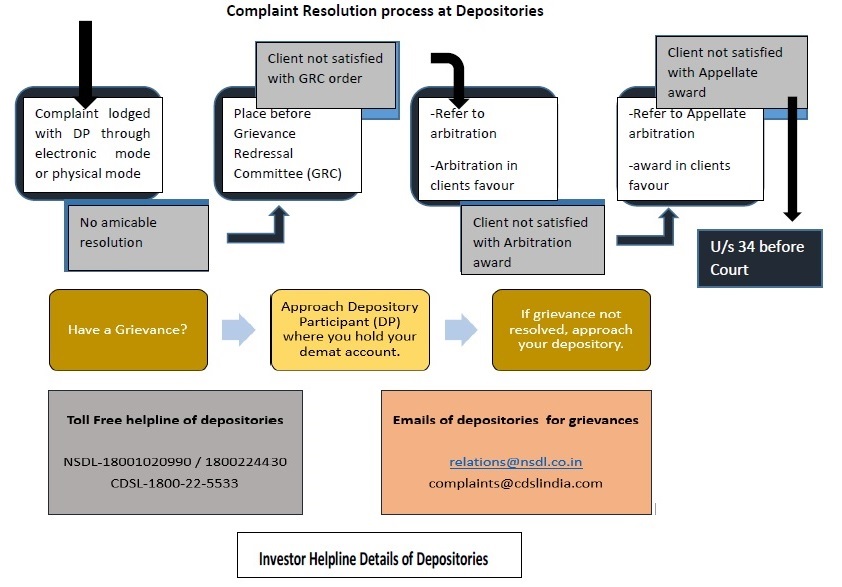
Disclosure Regarding Proprietary Trading
Dear Client,
We hereby disclose that in addition to client-based business, we are also doing proprietary trading.
Regards
MSB e-Trade Securities Limited






_Limited.svg.png)
 PORTAL